Downloads
DOI:
https://doi.org/10.47982/cgc.10.731Published
Issue
Section
License
Copyright (c) 2026 Michael Ludvik, Algis Lencus

This work is licensed under a Creative Commons Attribution 4.0 International License.
Abstract
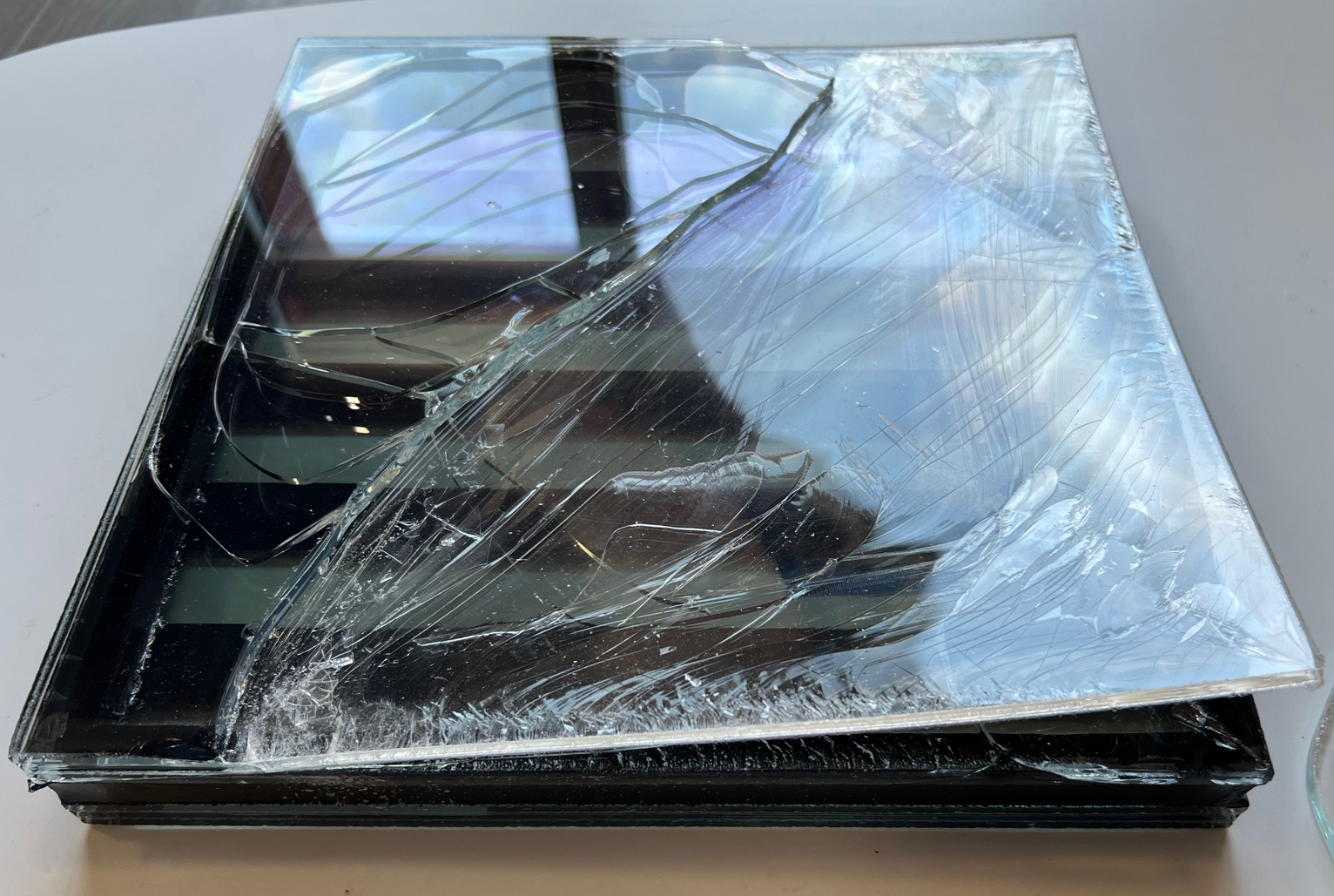
This paper presents behavior of thick interlayers under extreme cold temperatures, stemming from a review of failures of laminated glass panels for a public project in America’s Midwest. The glass included 4.57mm SentryGlas (SG) interlayer to achieve tornado resistance, which is three times the total thickness of typical SG interlayer. Failures, primarily in insulated spandrel areas, were initially attributed to high thermal stresses due to extreme cold winters (-36°C recorded) at the site location. Further study revealed that the contraction of the interlayer, exacerbated by its increased stiffness at low temperatures, was the major contributing cause. Finite element analysis (FEA) and freezer testing replicated the failures, showing Mode II substrate fractures where adhesion exceeded glass strength, leaving a thin glass skin on the interlayer. An additional failure mode was observed where the same contraction stresses exceed the adhesion strength of the interlayer, leading to delamination. Adhesion testing on site samples yielded "High" pummel values, indicating that glass and interlayer failure can occur at very cold temperatures with high interlayer adhesion. This study highlights risks of thick interlayers in cold climates and informs standards for structural glazing.