Downloads
DOI:
https://doi.org/10.47982/cgc.10.715Published
Issue
Section
License
Copyright (c) 2026 Christoph Bauchinger, Ingo Volkhausen

This work is licensed under a Creative Commons Attribution 4.0 International License.
Abstract
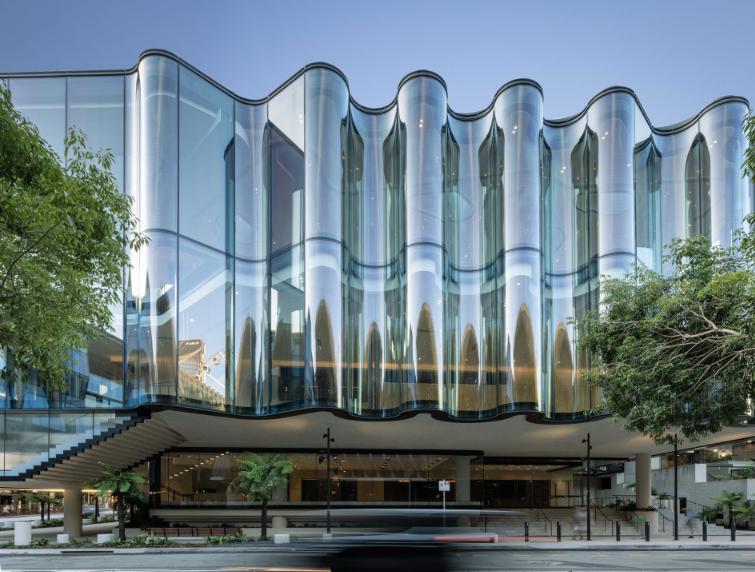
The Glasshouse Theatre Brisbane features a highly complex corrugated all-glass façade composed of alternating convex and concave curved insulating glass units with radii down to 1.0 m and panel heights up to 7.2 m. The realization of this geometry required precise control of fabrication tolerances, structural behavior and installation-induced deformations, as achieved through the engineering and execution by seele. The façade system is based on a discreet steel substructure with glass fins and structural silicone glazing (SSG) connections, enabling load transfer without visible mechanical fixings while maintaining a high degree of transparency. Parametric 3D modelling formed the basis of an integrated digital workflow, ensuring consistent geometric control from design through fabrication to installation. Finite element models incorporating geometric nonlinearity were developed to assess the structural behavior of curved glazing units and SSG joints under combined wind, thermal and installation loads. Full-scale mock-ups and digital measurement techniques were used to validate geometric accuracy, optical quality and interface tolerances, with deviations limited to the millimetre range. A dedicated installation strategy, including pre-loading of the supporting structure and the development of project-specific lifting equipment by seele, enabled controlled assembly of the façade under complex boundary conditions. The project demonstrates how advanced digital design methods, nonlinear structural analysis and precisely coordinated fabrication and installation processes enable the reliable realization of large-scale free-form glass façades with demanding geometric and structural requirements.