Lightweight and Optically Superior Curved Glazing with a High Curvature Range
Downloads
DOI:
https://doi.org/10.47982/cgc.10.672Published
Issue
Section
License
Copyright (c) 2026 Koen van Deurzen, Mauro Overend, Marcel Bilow

This work is licensed under a Creative Commons Attribution 4.0 International License.
Abstract
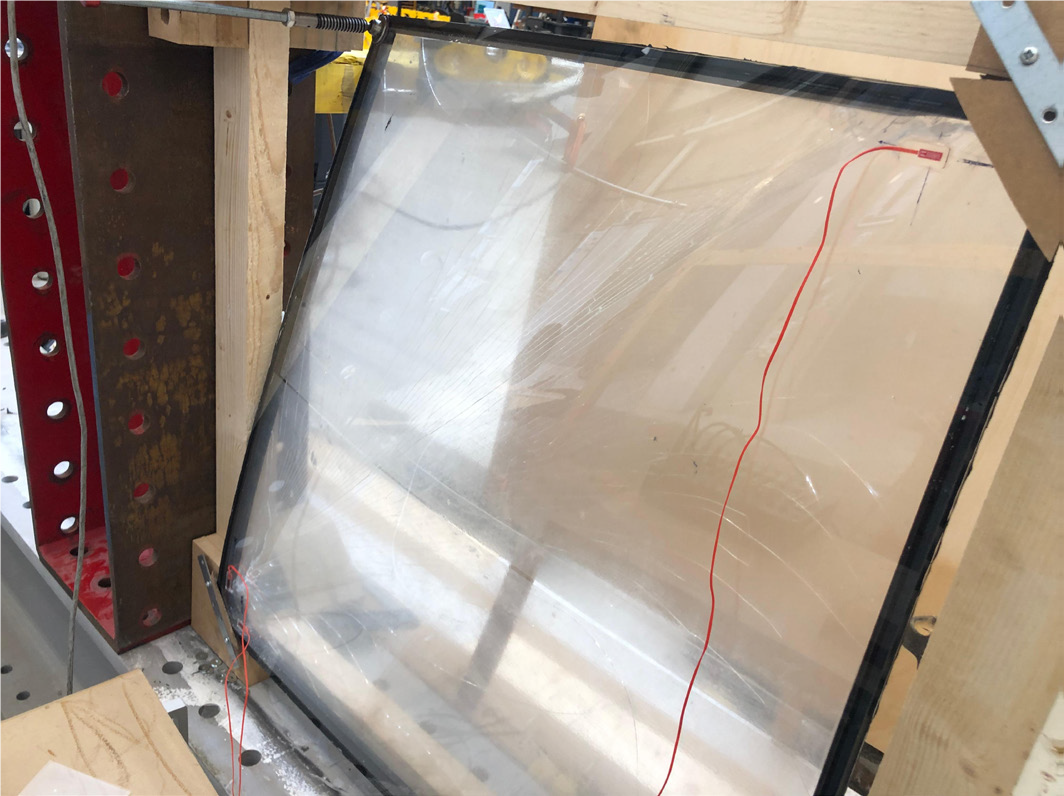
Recent developments in thin glass technology and flexible edge spacers present an opportunity to addresses notable fabrication challenges in conventional curved insulated glazing units, namely the undesirable visual distortions arising from hot bending the glass and the limited curvatures allowed by the glass strength. This study investigates the structural feasibility of flexible insulated glazing units (IGUs) incorporating chemically strengthened thin glass and a flexible spacer system, with the objective of enabling higher cold-bending curvatures than those achievable with conventional glass façades. And in doing so, the curvature imposed on the thin glass also provides the necessary stiffness to resist loads without excessive deflections. A combined methodological framework was adopted in this study, comprising finite element modelling to predict stress–strain behavior under controlled single-corner bending, alongside experimental validation through prototype fabrication and destructive testing. With additional material-scale mechanical tests to improve the accuracy of the numerical models. It was found that thin-glass IGUs can achieve a curvature ratio of 0.112, representing a 420% improvement on fully tempered IGUs with standard thickness glass. These findings demonstrate that thin-glass assemblies are capable of accommodating substantial geometric flexibility without compromising mechanical integrity, thereby reducing reliance on hot-bent glass in architectural applications.