A Performance-Based Framework for Material Characterisation, Structural Design and Thermal Shock Assessment
Downloads
DOI:
https://doi.org/10.47982/cgc.10.808Published
Issue
Section
License
Copyright (c) 2026 Vladimir Marinov

This work is licensed under a Creative Commons Attribution 4.0 International License.
Abstract
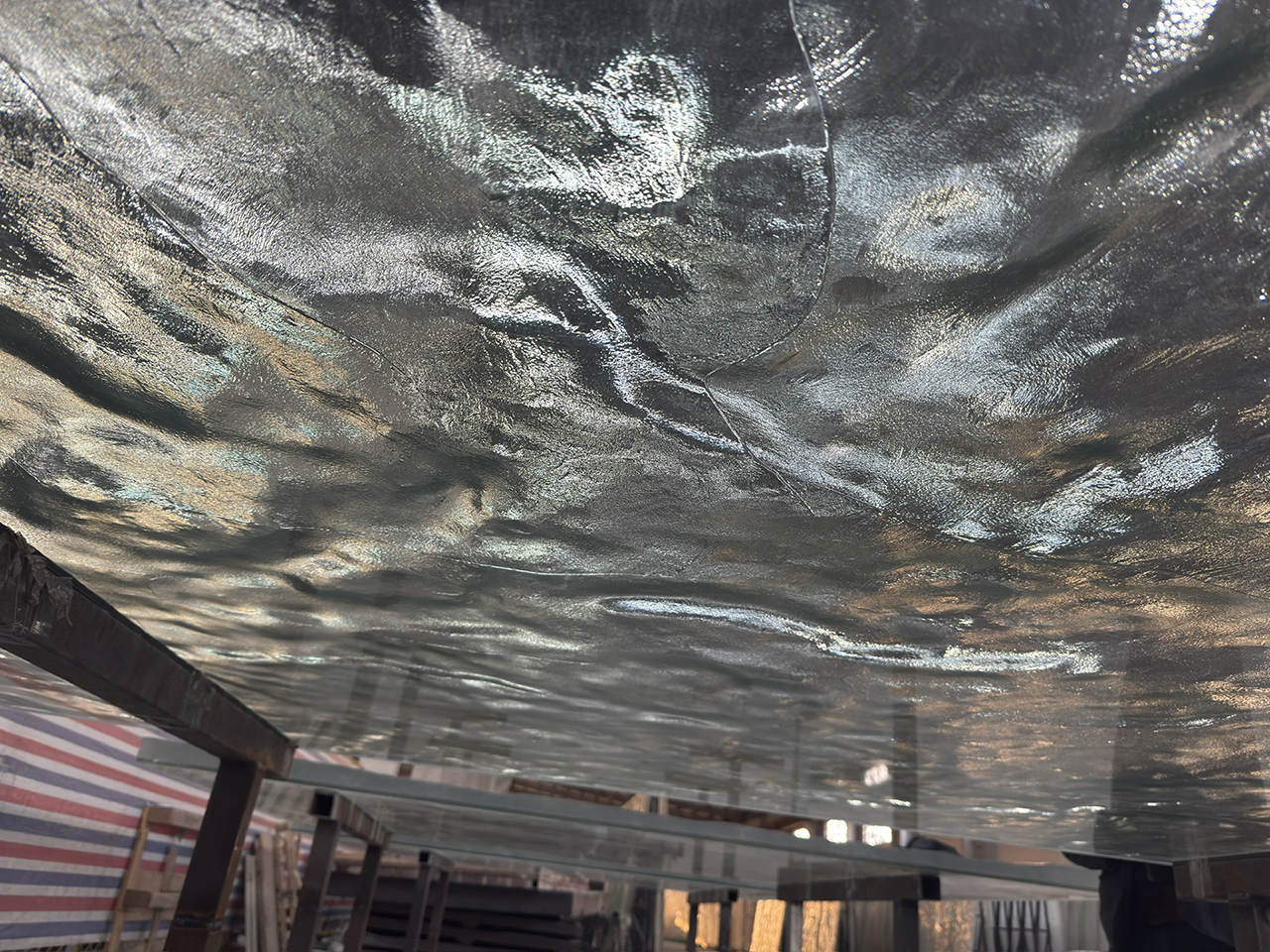
Cast borosilicate glass offers significant architectural potential for external façades, but its large-scale use is limited by the absence of established design data and standardised verification methods. This paper presents a performance-based methodology for thick, undulating cast borosilicate glass panels laminated to borosilicate float glass. Project-specific testing was undertaken to determine density, elastic modulus, thermal expansion and bending strength. The strength data were assessed using Weibull statistical methods, comparing EN, ASTM and weighted least-squares regression approaches.
A calibrated equivalent-thickness method was developed to translate scanned three-dimensional cast geometries into practical shell models for façade analysis. Structural verification considered self-weight, wind loading, support conditions, local bracket zones and laminated glass interaction. Thermal shock risk was assessed using measured optical properties, local climatic data, solar radiation modelling and façade-specific shading scenarios. The resulting temperature differentials were converted into thermal stresses and checked against probabilistically derived material capacities. The work demonstrates a repeatable framework for combining testing, probabilistic design, finite element calibration and environmental assessment in non-standard façades.