DOI:
https://doi.org/10.47982/cgc.10.800Published
Issue
Section
License
Copyright (c) 2026 Emily Lenarduzzi, Simos Maniatis, Alessandra Luna-Navarro, Michaël Peeters, Hadrien Heuclin, Francois Guillemot, Rebecca Hartwell

This work is licensed under a Creative Commons Attribution 4.0 International License.
Abstract
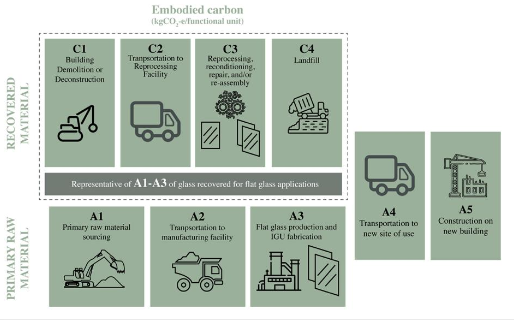
The reuse and high-value recovery of architectural glazing offer significant potential to reduce waste and minimize the environmental impact of the glass sector. Still, there is a lack of a standardised approach to support decisions in environmentally efficient renovation pathways that integrate all life-cycle stages and account for varying glazing types, geographical locations, and service-life dynamics. This study develops a novel assessment framework to quantify the environmental and financial trade-offs of alternative glass recovery pathways. The computational framework incorporates life-cycle embodied carbon analyses across material recovery scenarios and temporal energy simulations parameterized by panel geometry, build-up, window condition, and collection site. The framework was applied to six reference glazing products in residential and commercial case studies located in France. It was found that carbon payback periods range from under five years for deteriorated early-generation glazing to well beyond 25 years for non-deteriorated products or products subject to high-infiltration conditions, highlighting the importance of existing building condition in guiding intervention decisions. Under current market conditions, it is shown that despite their embodied carbon benefits, reuse and remanufacturing both incur substantially higher 30-year net present value costs (EUR) compared to recycling recovered glazing and installing new high performance IGUs.