DOI:
https://doi.org/10.47982/cgc.10.795Published
Issue
Section
License
Copyright (c) 2026 Lena Efferz, Christian Schuler, Geralt Siebert

This work is licensed under a Creative Commons Attribution 4.0 International License.
Abstract
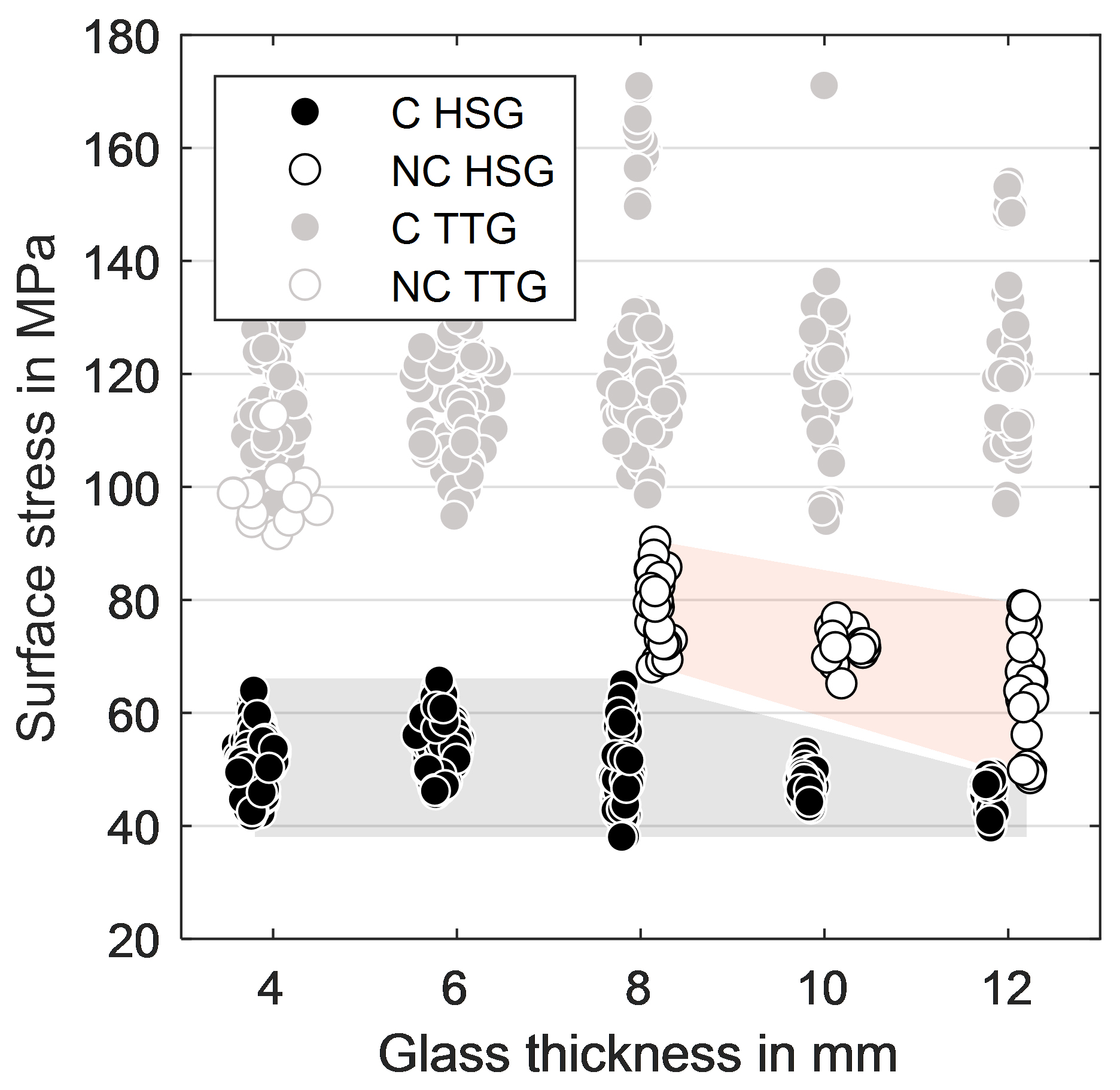
Heat-strengthened glass requires a carefully controlled tempering process to achieve the desired residual stress state. On the one hand, the required bending strength of 70 MPa must be ensured. On the other hand, the characteristic, coarse fracture pattern of heat-strengthened glass must be maintained so that laminated glass elements retain residual load-bearing capacity after breakage. In current quality control procedures, these requirements are typically verified by destructive testing. Photoelastic measurement of residual stresses provides a non-destructive method for evaluating the stress state in glass panes. However, defining suitable limit values for heat-strengthened glass remains challenging, as a permissible range rather than a single threshold is required. This study presents a statistical determination and evaluation of photoelastic limits for heat-strengthened glass based on measurements of surface and edge stresses. In addition, thickness-dependent behavior is investigated, since current limit values in standards and literature generally do not account for glass thickness. Finally, the study discusses whether the proposed limits can improve the reliability of non-destructive quality control and support the assessment of heat-strengthened glass components in practical applications.