Lessons-Learnt from Relocating and Upgrading Human–Façade Interaction Lab
Downloads
DOI:
https://doi.org/10.47982/cgc.10.780Published
Issue
Section
License
Copyright (c) 2026 Alessandra Luna Navarro, Marcel Bilow, Pablo Martinez-Alcaraz, Pedro de la Barra, Tim Jonathan, Atze Boerstra

This work is licensed under a Creative Commons Attribution 4.0 International License.
Abstract
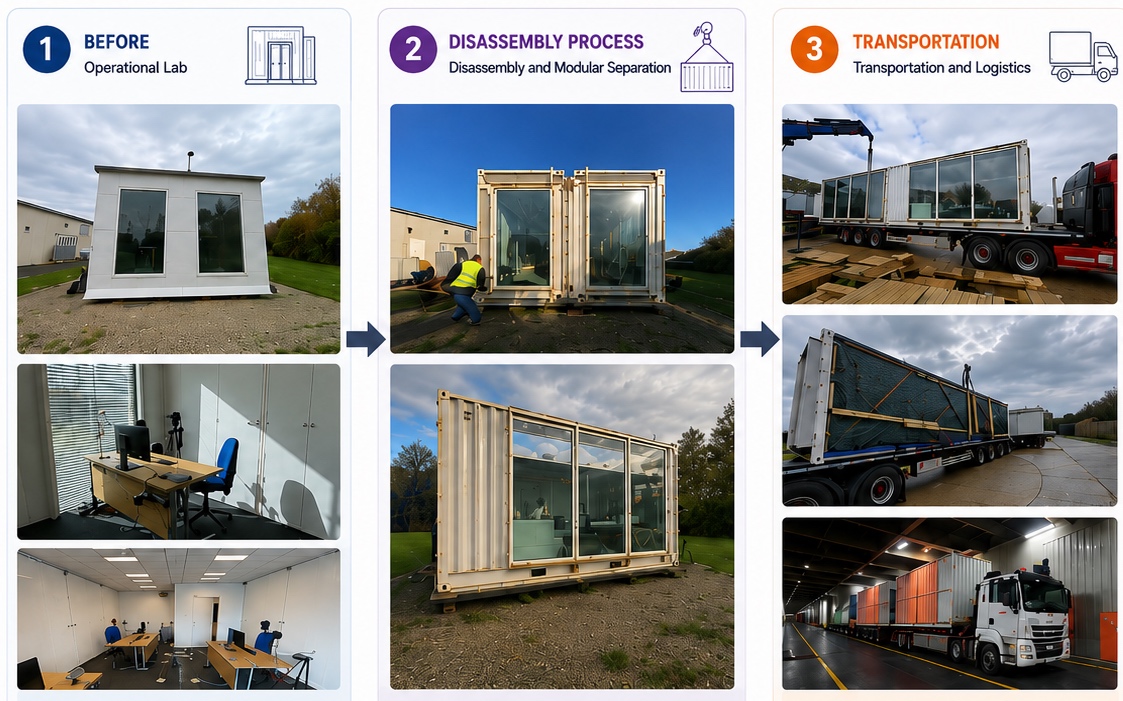
Experimental research on human–façade interaction is essential for advancing user-centered façade and glazing technologies, particularly in relation to serviceability of glass and façade technologies, multi-domain comfort and resilience and acceptance with novel technological approaches. Yet only a limited number of laboratories worldwide provide flexible, reconfigurable, and realistically scaled test environments capable of hosting human participants. The MATELab—originally inaugurated in 2018 in Cambridge (UK)—is one such facility. In 2024, the lab underwent a full relocation and upgrade when the laboratory was disassembled and moved at Delft University of Technology. This paper presents the lessons learned from the relocation process, highlighting both the logistical and scientific challenges of transferring a human–subject testing laboratory across contexts. Beyond documenting the practical constraints of reassembling complex façade test rigs, we discuss how the move enabled significant functional and methodological improvements to better support research on human responses under changing climatic conditions and emerging societal challenges. The insights provided aim to inform future efforts to establish human–facade interaction laboratories and research directions.