Downloads
DOI:
https://doi.org/10.47982/cgc.10.777Published
Issue
Section
License
Copyright (c) 2026 Julius Seifert, Nathalie Nießer, Geralt Siebert

This work is licensed under a Creative Commons Attribution 4.0 International License.
Abstract
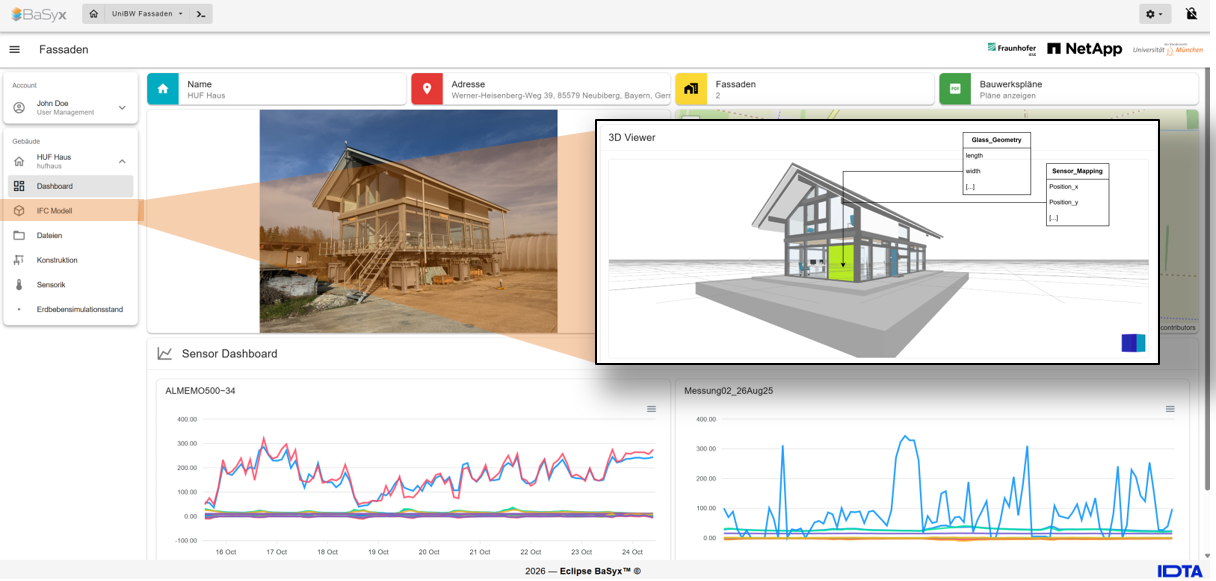
The integration of digital twin concepts into glass-intensive building structures offers new perspectives and challenges for structural validation and monitoring. This contribution presents an adaptation of the standardized Asset Administration Shell (AAS) to a full-scale experimental timber–glass building subjected to seismic excitation at the University of the Bundeswehr Munich (UniBw M). The structure features load-bearing glazing panels acting as horizontal bracing elements within a timber frame system. A hierarchical AAS-based architecture is introduced in which structurally relevant glass components are represented through semantically defined submodels capturing geometry, material properties, boundary conditions, load cases and sensor mappings. Building upon previous hybrid Digital Twin concepts for structural glass monitoring, the proposed framework establishes a structured linkage between analytical design models and experimentally recorded strain data. The prototypical implementation demonstrates how AAS-based digital asset modeling can be extended toward brittle structural components under dynamic loading, providing a foundation for component-level validation and future condition-based assessment strategies.