Downloads
DOI:
https://doi.org/10.47982/cgc.10.776Published
Issue
Section
License
Copyright (c) 2026 Nathalie Nießer, Julius Seifert, Geralt Siebert

This work is licensed under a Creative Commons Attribution 4.0 International License.
Abstract
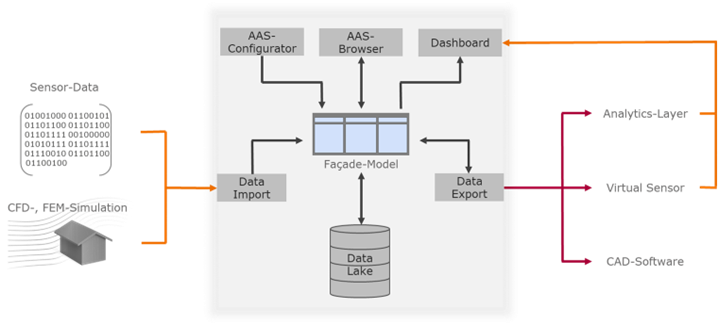
In recent decades, the proportion of glass façades in architecture has risen markedly, from complex structures to standardised system solutions. This trend has generated interest in using glass not only as a transparent cladding material but also as a key component of the building's supporting framework, enhancing its overall stiffness. At the University of the Bundeswehr Munich (UniBw M), research is ongoing to understand how glazed elements behave under stress, with the aim of exploring their capacity to develop effective shear and in-plane stiffness. Large-scale tests show that with proper edge stiffening, glass can transfer significant compressive and shear forces, thereby helping to stiffen buildings. Simultaneously, gaps in planning, verification, and inspection practices highlight a pressing need for optimisation in façade technology that cannot be fully addressed by implementing Building Information Modelling (BIM). Consequently, sensor-based monitoring systems are being developed to provide ongoing condition assessments. When combined with a digital twin, which acts as a bridge between measurements and simulations, the goal is to perform smart, condition-based façade monitoring with real-time recommendations for action. This article outlines ongoing research at UniBw M that integrates experimental, numerical, and sensor-based methods to measure the structural role of load-bearing glazing in a full-scale test setup.