Downloads
DOI:
https://doi.org/10.47982/cgc.10.770Published
Issue
Section
License
Copyright (c) 2026 Steffen Feirabend, Angelika Schmid, Roland Bechmann

This work is licensed under a Creative Commons Attribution 4.0 International License.
Abstract
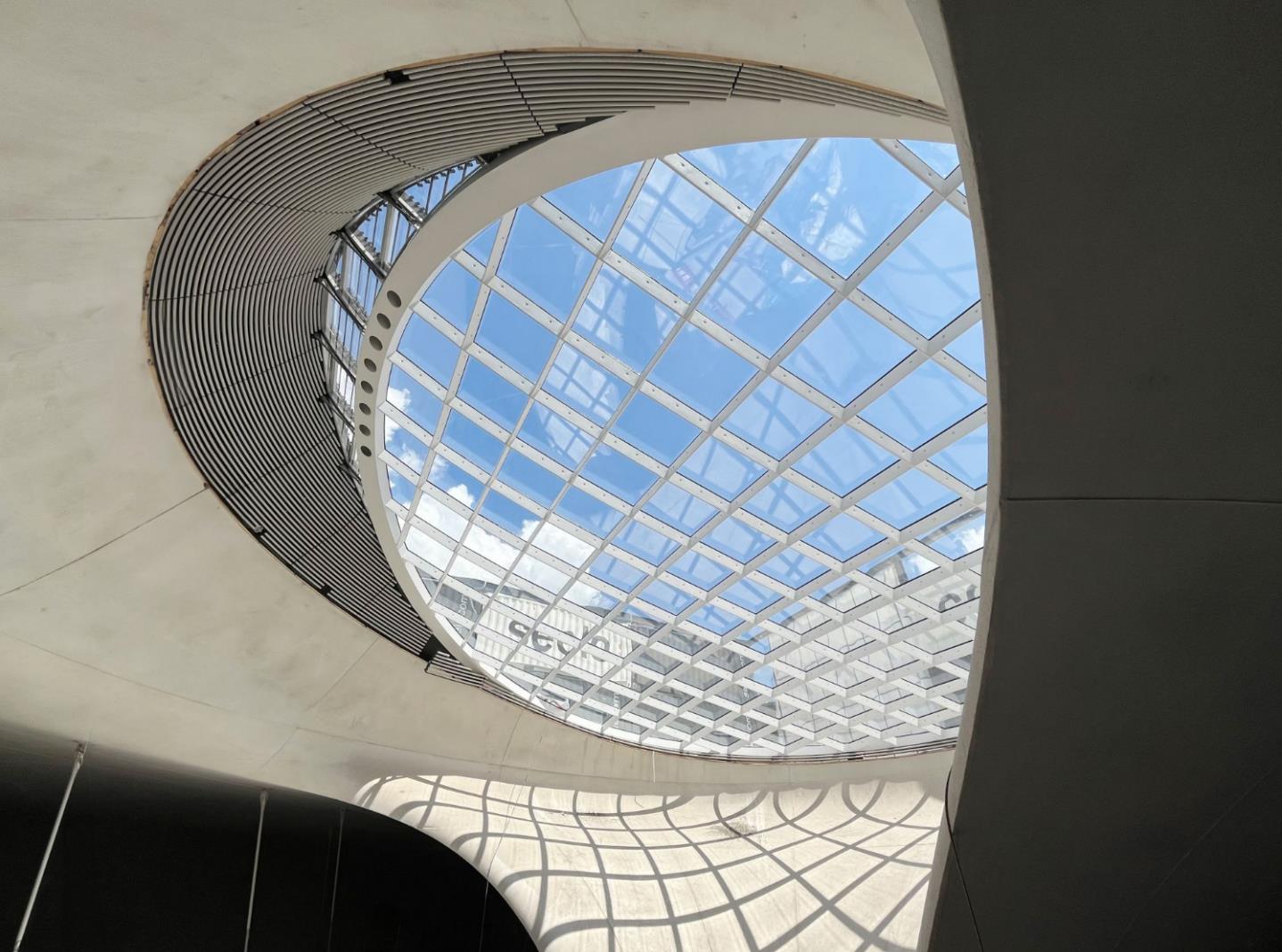
The S21 railway project requires a large number of structural changes in Stuttgart, these include the construction of a new railway station. This new underground station consists of an approx. 447 m long and 80 m wide hall - a shell structure supported by so-called 28 chalice-shaped columns based on a design concept by Christoph Ingenhoven together with Frei Otto. The chalice concrete columns are open at the top and covered by steel-glass structures known as the so-called light eyes. The light eyes allow daylight to flood deep into the underground platform hall and minimizing artificial lightning. Furthermore, ventilation flaps in the transition areas between the glazed light eyes and the reinforced concrete structure allow natural ventilation and – through air exchange with the tunnel tubes – natural air conditioning. 23 light eyes have an anticlastical curved surface (a so-called translational surface) which can be covered with flat square laminated glass units. There are in addition also 4 flat light eyes. The 3 glazed grid shells (at the Bonatz Tower, at the subway station Staatsgalerie and on Kurt-Georg-Kiesinger- Square on top of a chalice-shaped column) form the entrance structures to the platform hall. The surfaces of the grid shells are triangulated torus sections with a curved vertical facade for the entrances. The resulting triangular meshes are covered with laminated glass. In addition to the complexity of the steel-glass structures itself, the expected deflections of the supporting concrete structure beneath have to be taken into account in the design.