Downloads
DOI:
https://doi.org/10.47982/cgc.10.763Published
Issue
Section
License
Copyright (c) 2026 Chiara Bedon, Massimo Ciocca, Gerardo Masiello, Sabato Gargiulo, Nicola Cella

This work is licensed under a Creative Commons Attribution 4.0 International License.
Abstract
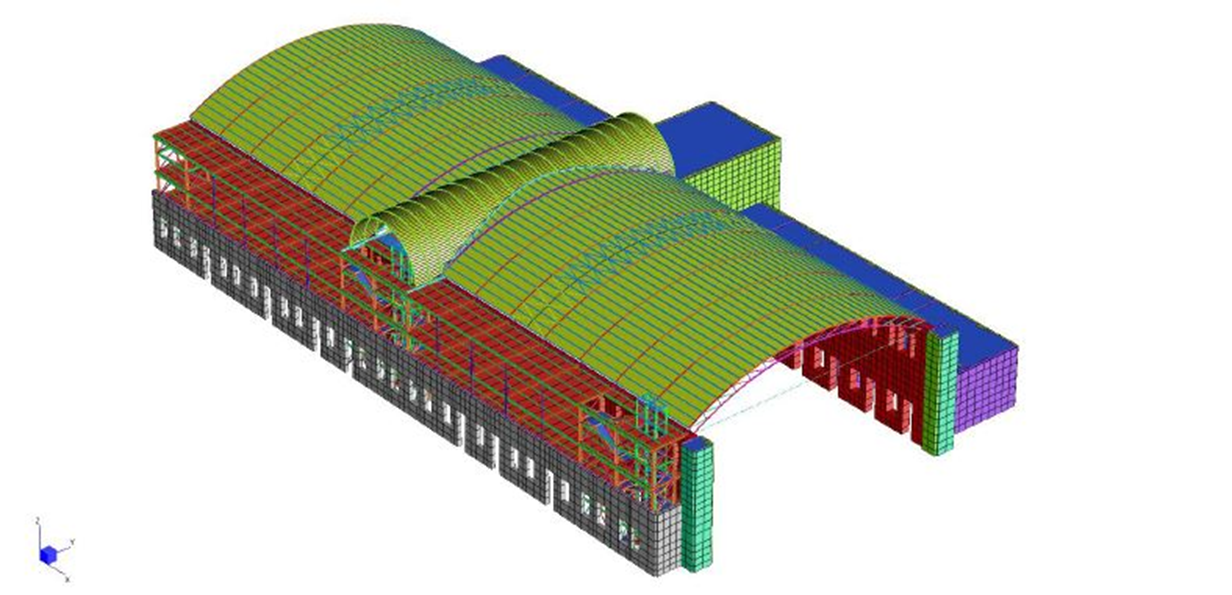
The retrofit and requalification of the historic Campo Marzio railway station in Trieste (Italy) includes the reconstruction of its former vaulted glass roof, a suspended pedestrian walkway to host a restaurant, and a new main façade. The new steel and glass structures reinterpret the original early-20th-century layout through lightweight reticular arches and cold-bent laminated glass panels. The structural verification of the glass components involved seven different typologies for curved and planar panes, which were designed by means of dedicated FEM analyses. The dynamic response of the roof subjected to wind loading represents indeed an important step of the analysis, as the building is in the city of Bora wind. This issue is assessed through coupled CFD and structural simulations. RWIND 2 is first used to evaluate the spatial distribution of external and internal pressures, while nonlinear dynamic analyses are carried out in ABAQUS to capture the vibration modes and the possible aeroelastic amplification effects under turbulent flow. The integrated numerical approach ensures the structural safety and serviceability of the transparent envelope while preserving its architectural lightness and historical identity within a contemporary structural concept.