Downloads
DOI:
https://doi.org/10.47982/cgc.10.762Published
Issue
Section
License
Copyright (c) 2026 Peter Eckardt, Kathrin Rauh, Steffen Dix

This work is licensed under a Creative Commons Attribution 4.0 International License.
Abstract
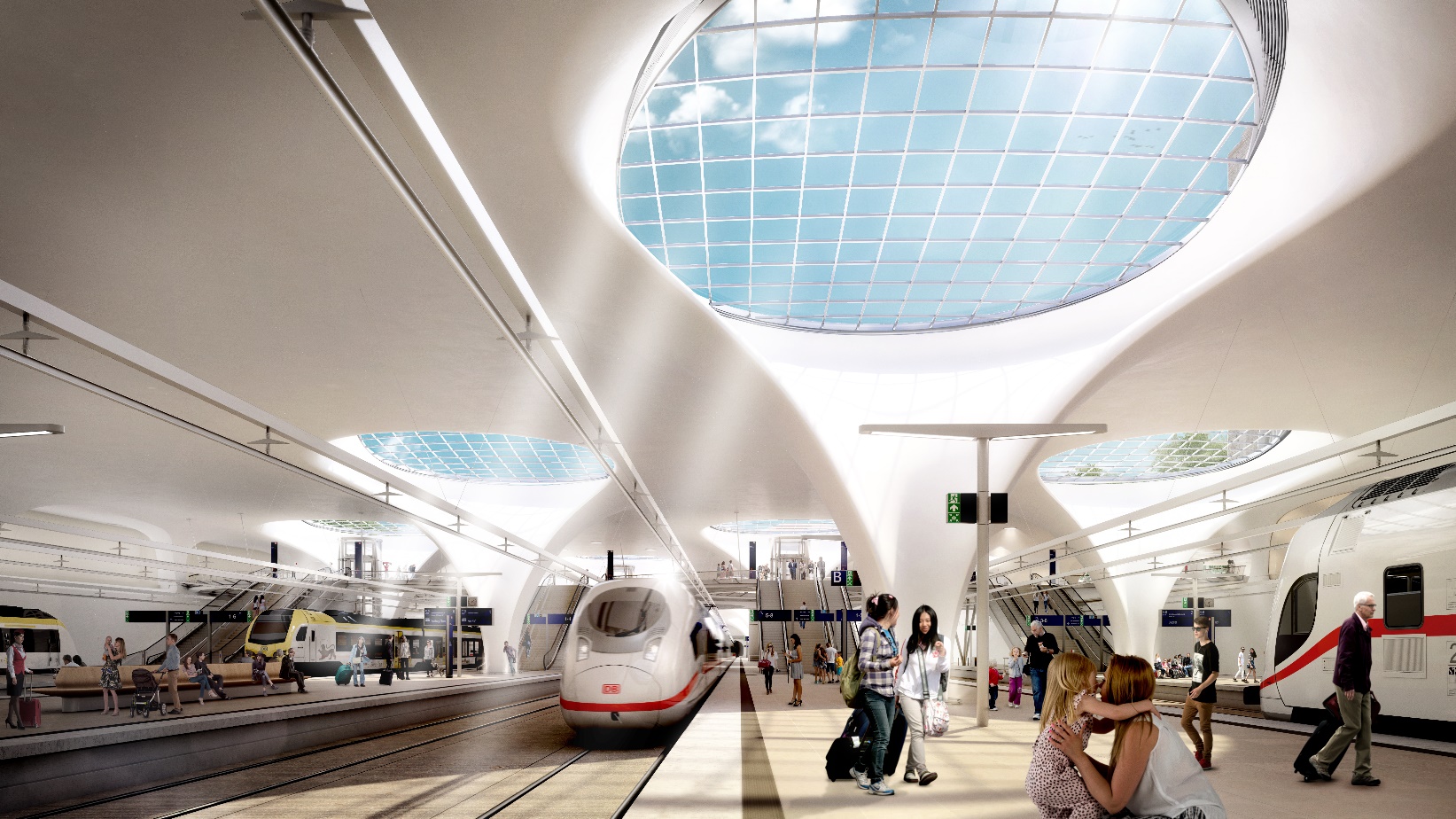
The new underground main station Stuttgart 21, designed by Christoph Ingenhoven with ingenhoven associates, is characterized by its distinctive reinforced concrete structure with iconic column-like “chalices” supporting large skylight openings, the so-called light eyes. These sculptural structures provide natural daylight and ventilation to the subterranean concourse and define the architectural identity of the station. In total, 23 regular light eyes consist of double-curved, anticlastic welded steel structures glazed with flat laminated glass panes. Integrated glass natural smoke and heat exhaust ventilators (NSHEV), as well as demanding requirements for maintenance accessibility and residual load-bearing capacity, posed particular challenges for design and verification. Four additional, flat light eyes feature enhanced glazing capable of withstanding exceptional loads caused by unforeseen crowd accumulation. Complementing these skylights are three lightweight gridshells made of steel and glass forming transparent access structures that connect the urban space with the underground platforms. The paper provides insight into the specific challenges related to the structural design of the glazing, the verification of extraordinary load cases, the approval process, and the complex procedures for fabrication and installation. Both engineering and regulatory solutions that enabled the realization of these unique glazed systems are discussed.