A Study on the Remodelling of a Glass Drum
Downloads
DOI:
https://doi.org/10.47982/cgc.10.761Published
Issue
Section
License
Copyright (c) 2026 Andreas Komm, Holger Krueger, Georg Prennschuetz, Alexandros Cannas, Minxi Bao

This work is licensed under a Creative Commons Attribution 4.0 International License.
Abstract
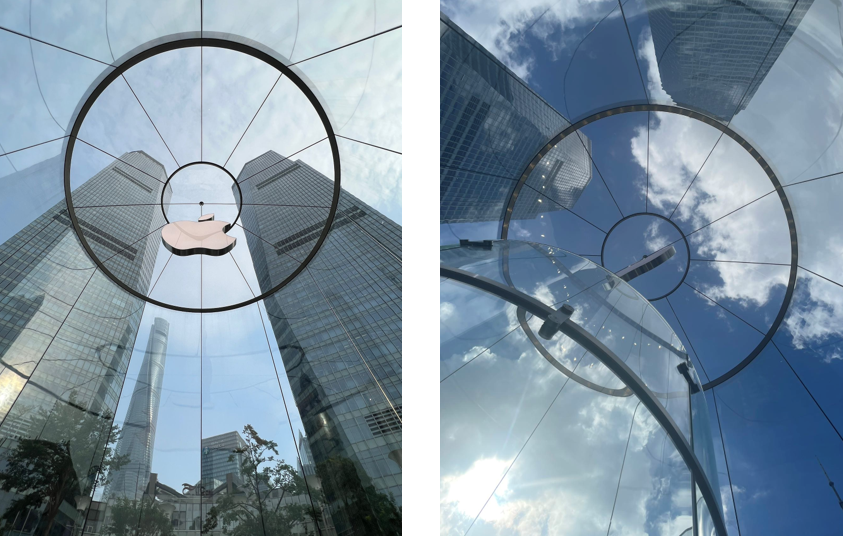
This paper presents the remodelling of a retail store in Shanghai, where an existing glazed drum of 10 m diameter and 12 m height, originally composed of glass fins and beams with infill panels, was transformed into a minimally supported structural glass enclosure while retaining the original architectural proportions. The paper first outlines the project background and the design intent to replace a conventionally framed system with a shape-driven glass structure. It then discusses the key design principles, the structural concept, and the load path developed through the interaction of drum geometry, domed roof geometry, bearings, silicone bonding, and glass stiffness. Particular attention is given to the behaviour of the system under different load conditions, including dead load, maintenance load, and fluctuating wind actions, with emphasis on the sensitivity of the slender roof structure beyond peak design values alone. The analytical design approach is presented together with the validation strategy, comprising full-scale testing of the roof and a full drum mock-up performed in parallel in two countries for both robustness and compliance. The paper further addresses fabrication tolerances, local expertise, and installation-related constraints as essential factors in the successful realization of the project. The study demonstrates how geometry-led design, targeted validation, and close interdisciplinary collaboration can enable a lean and robust all-glass system for demanding architectural applications.