Downloads
DOI:
https://doi.org/10.47982/cgc.10.759Published
Issue
Section
License
Copyright (c) 2026 Rohola Rahnavard, Eliana Inca-Cabrera, Sandra Jordão, Carlos Rebelo

This work is licensed under a Creative Commons Attribution 4.0 International License.
Abstract
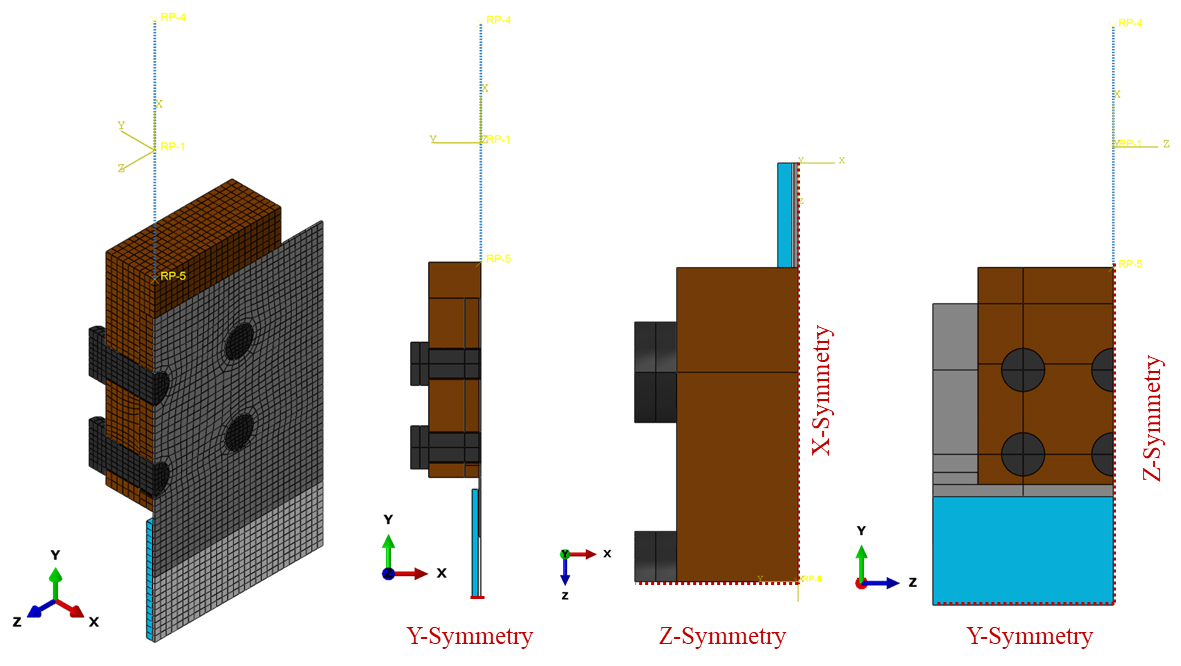
Embedded stainless steel–glass connections are widely used in transparent structures, but their mechanical behaviour depends on stress transfer through polymer interlayers. This study investigates an embedded stainless steel–glass detail with a polyvinyl butyral (PVB) interlayer and evaluates a finite-element model in Abaqus. Three laboratory tests were performed on identical specimens under monotonic loading. All specimens failed by delamination at the embedded interface. The model treats glass and steel as linear elastic, the PVB as a deformable interlayer, and uses an adhesive-zone (traction–separation) law to capture damage initiation and evolution. Geometric nonlinearity and contact simulate separation and post-peak behaviour. Predictions were compared with measurements, including global force–displacement response. The simulation reproduced stiffness, peak load, and post-peak softening across all three tests and correctly localised damage along the embedded edge. This close correspondence demonstrates the reliability of the modelling technique for assessing embedded steel–glass connections with PVB interlayers. The results provide a validated basis for parametric studies and predictions of capacity and failure modes in laminated glass assemblies.