Downloads
DOI:
https://doi.org/10.47982/cgc.10.758Published
Issue
Section
License
Copyright (c) 2026 Mir Zafarullah, Nicola Cella, Chiara Bedon, Pasquale Lucia

This work is licensed under a Creative Commons Attribution 4.0 International License.
Abstract
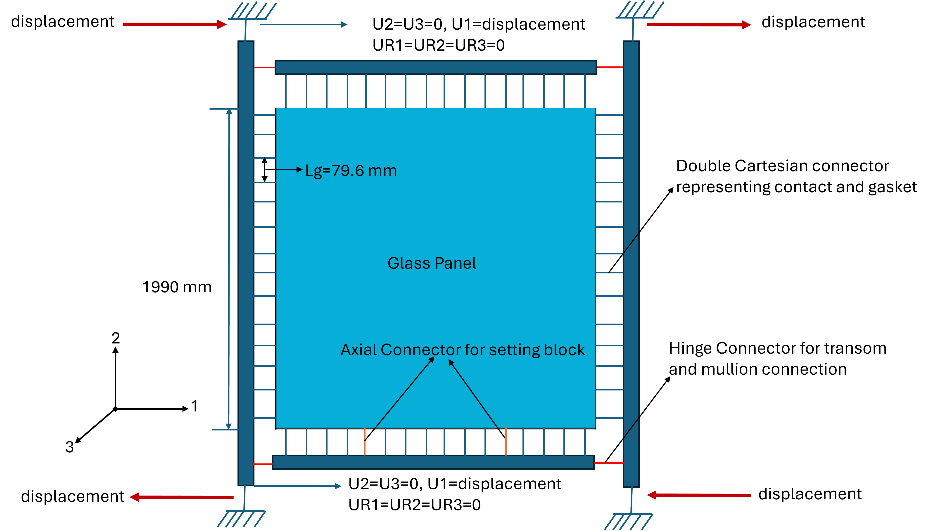
Major design challenges in facades for multi-story buildings are represented by extreme loading conditions, such as earthquakes. The mechanical response of glass systems, particularly against dynamic loads, is in fact extremely unpredictable, due to a combination of multiple aspects. Even few details (i.e., connectors) can strongly modify the overall structural performance, in terms of global stiffness, load-bearing capacity, failure mechanisms, etc. Therefore, to accurately detect the true behaviour, performance indicators and resisting mechanisms of glass against such loads, robust testing protocols, and optimized numerical approaches are required. In this study, two different glass facades (Point Fixed Glass Facade (PFGF) and framed glass facade) are subjected to conventional experimental protocols, to numerically explore and compare their mechanical response against in-plane seismic loads. The analysis starts from the preliminary design of the minimum glass thicknesses that are required to sustain the ordinary mechanical loads (wind and self-weight). Under in-plane seismic conditions, as expected, the numerical results show that the two systems behave strongly different. The response of the framed glass facade is highly influenced by the clearance between the glass panel and the frame, while in PFGF the slotted holes play a key role. The PFGF is indeed more vulnerable to seismic loads than the framed system. The higher stress concentration and deflection were observed in PFGF, while framed glass facades behaved more robustly in the same loading conditions.