A Numerical Study on Blast Response
DOI:
https://doi.org/10.47982/cgc.10.750Published
Issue
Section
License
Copyright (c) 2026 Chiara Bedon, Damijan Markovic, Ralf Schumacher, Vasileios Karlos, Martin Larcher, Marco Ooms

This work is licensed under a Creative Commons Attribution 4.0 International License.
Abstract
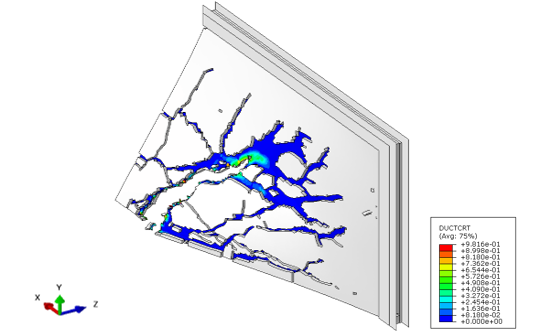
This paper presents a numerical study on the resistance of windows with Anti-Shatter Film (ASF) against explosive loading. The evolving terrorism threat, particularly the increased use of drone-borne explosives, put an emphasis on appropriate window protection. This calls for a specific focus on blast load scenarios against glass facades. In this paper, attention is given to the blast response of traditional monolithic glass windows, and a reference system with 6 mm thickness (1590 mm × 1190 mm the dimensions) is taken into account. Introducing a 0.15 mm thick ASF. Initially, the effects of the ASF properties are assessed under standard far-field blast load conditions (R= 40 m the explosive-to-window distance and W= 100 kg the charge of equivalent TNT). The analysis shows a significant sensitivity of the performance of the ASF to its properties, and thus its benefits in terms of safety level of the target window as a whole. Additionally, focusing on a drone-related threat scenario, two near-field blast conditions are analysed, with the explosive-to-window distance reduced to R= 2 m and R= 1 m respectively. Parametric results are critically discussed, by comparing the blast responses in qualitative and quantitative terms.