Development of the Design Flaw and Cumulative Load Duration for Hurricanes
Downloads
DOI:
https://doi.org/10.47982/cgc.10.744Published
Issue
Section
License
Copyright (c) 2026 Richard Green, Isabelle Green

This work is licensed under a Creative Commons Attribution 4.0 International License.
Abstract
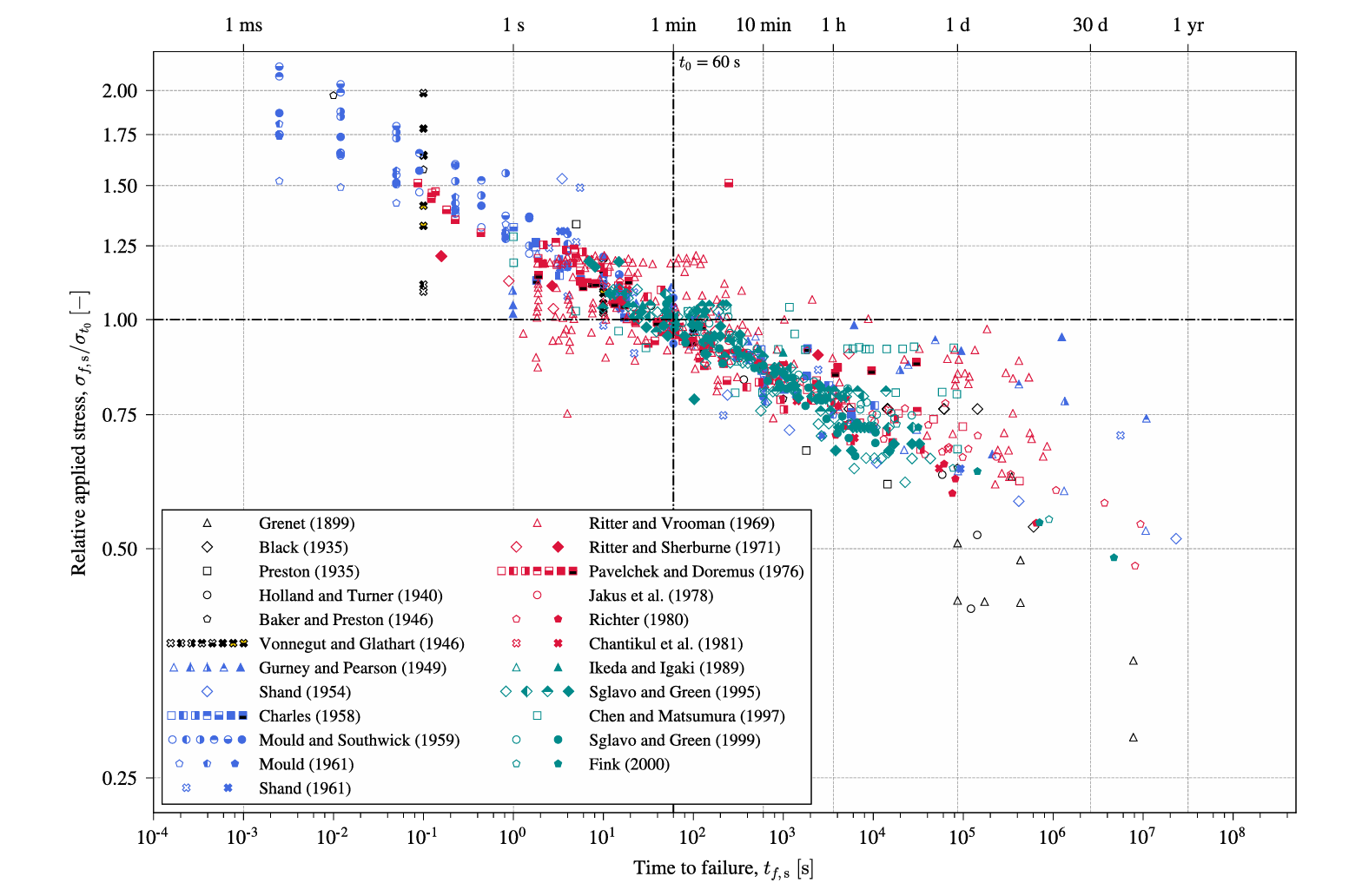
Glass design standards include an allowance for load duration but are silent on the capacity of glass immediately following a near-design-duration load event and the capacity to sustain subsequent loading. They treat loading events as isolated occurrences rather than cumulative phenomena. Typically, wind loads are treated as 3 second load duration, regardless of the type of storm or the associated gust patterns and cumulative duration. For this to be true, the glass must heal somewhat between the loading events, if not to the level of fresh glass, then healing to the level of surface flaw assumed in the design standard. This paper explores the dynamic nature of flaw-development in glass from fresh to weathered states and self-healing from design-duration-loaded state to re-establishment of design level resistance. In prior research these effects have mostly been treated separately; this paper examines both the mechanisms that contribute to “weathering” and “self-healing” of glass, as well as climatic data in the context of cumulative wind load event duration. Particular attention is given to evaluating appropriate load durations for atypical sustained-wind events such as hurricanes, cyclones, and typhoons. This paper reviews prior material from disparate areas and proposes revised design practices for areas prone to hurricane events. It contrasts window glass and structural glass assemblies and the implications for standardization and design of structural glass.