Downloads
DOI:
https://doi.org/10.47982/cgc.10.739Published
Issue
Section
License
Copyright (c) 2026 Sajjad Karimi, Yiding Liu, Antonios Kanellopoulos, Kyriaki Corinna Datsiou

This work is licensed under a Creative Commons Attribution 4.0 International License.
Abstract
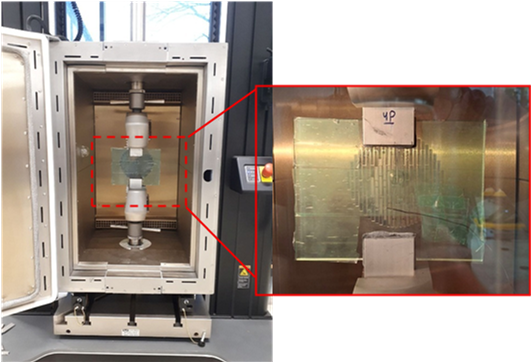
Adhesive bonding has gained in popularity within the construction sector for its capacity to bond dissimilar materials and distribute stress. Silicone bonded facades (silicone structurally glazed), when reached their end of life, can be disassembled using cutting tools. However, to improve glass-frame separation and enable circularity, this study examines, for the first time, the debonding-on-demand potential of a structural silicone adhesive modified with Thermally Expandable Particles (TEPs). This research evaluates the mechanical performance and triggered disassembly of glass-aluminium joints focusing on a 10 wt.% TEP concentration. Experimental testing characterised intrinsic tensile properties via dogbone specimens and joint strength through single lap shear tests under ambient temperature. Additionally, synchronised thermal-mechanical tests were conducted at 180 °C under constant preload to quantify debonding potential. The results demonstrated a dual-functional behaviour: the 10 wt.% TEP formulation enhanced ambient tensile strength by 16%, making it superior to the pure adhesive. On the other hand, upon thermal activation, this formulation achieved complete on-demand separation within 32 mins. This confirms that the internal expansion pressure successfully overcomes the interfacial bond strength at a load representing only 10% of the joint's ultimate capacity. These findings present a promising approach for enabling high-value recycling of facades directly contributing to the circular economy in the built environment.