DOI:
https://doi.org/10.47982/cgc.10.736Published
Issue
Section
License
Copyright (c) 2026 Franz Paschke, Miriam Schuster, Michael Kraus, Matthias Seel

This work is licensed under a Creative Commons Attribution 4.0 International License.
Abstract
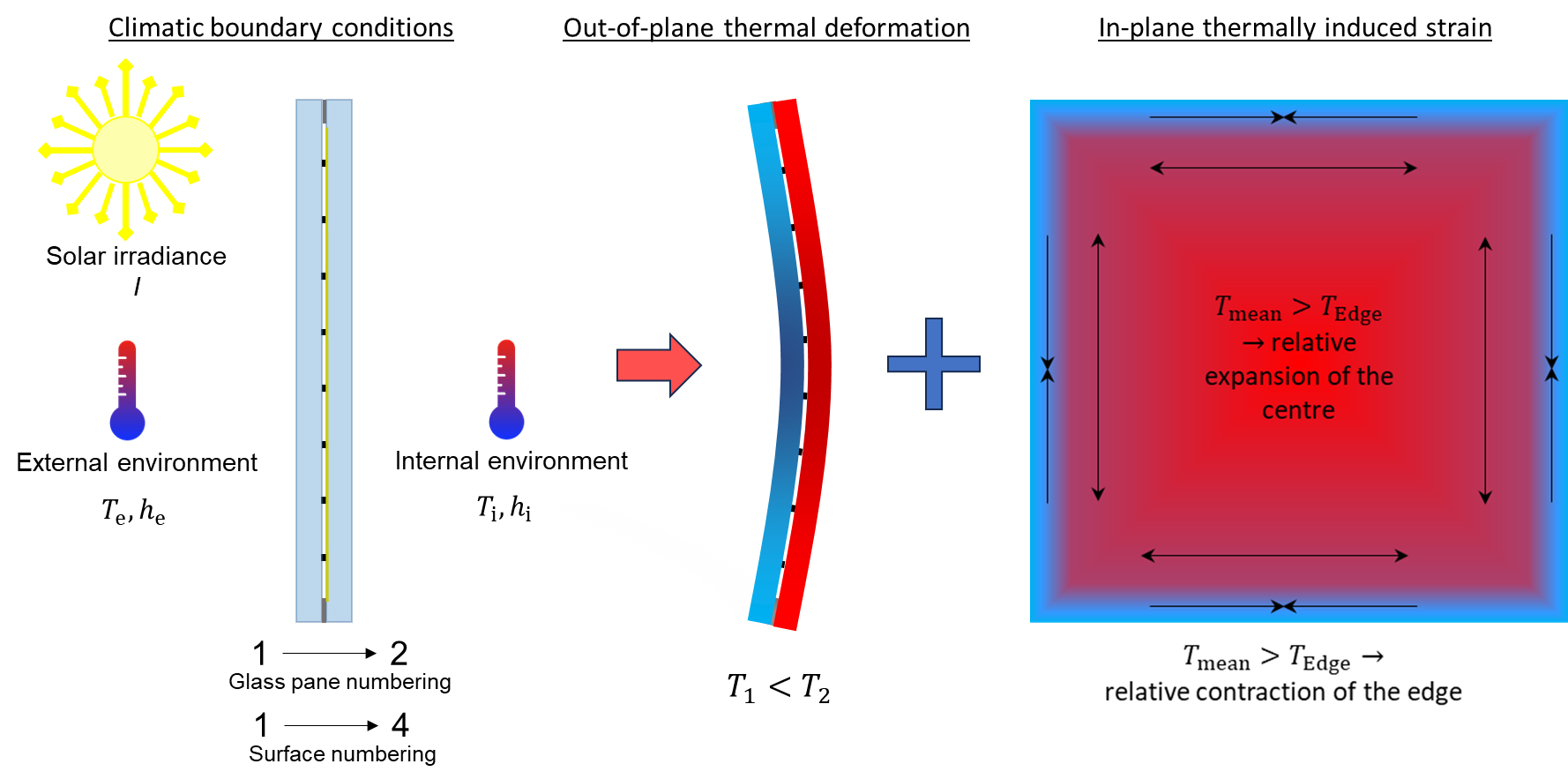
Vacuum insulating glass (VIG) enables high-performance façades, but its broad implementation requires standardized design methods. In addition to wind, snow, and self-weight, VIG is exposed to thermal actions governed by climatic boundary conditions. Ambient air temperatures, external heat transfer coefficients, and solar irradiance generate temperature gradients across the assembly that induce deformations and stresses. The thermal effects of these boundary conditions were experimentally reproduced in a temperature test stand by imposing temperature gradients (ΔT) on 350×350 mm² annealed float glass VIG specimens under unconstrained ('free-edge') support conditions. Experimental results demonstrate that thermal actions alone can result in thermally induced fracture at the edge of the warm glass pane once a specific temperature difference threshold is exceeded. This threshold is evaluated against critical climatic conditions applicable to insulating glass. A design-compatible superposition of thermal actions with other loads is proposed, and the structural resistance applicable to the thermal action case is discussed. Furthermore, an analytical model is provided to derive the thermal actions on the VIG arising from varying climatic boundary conditions, alongside a discussion on the limits of existing stress calculation methods and a complete verification procedure. Finally, the paper reviews the standards governing thermal actions (DIN 18008-1, 2020; EN 1991-1-5, 2010; EN 19100-1, 2024) and contextualizes the proposed design concept within existing frameworks to support a harmonized VIG design.