A Sensitivity Study on Life Cycle Impact Assessment
DOI:
https://doi.org/10.47982/cgc.10.732Published
Issue
Section
License
Copyright (c) 2026 Philipp Kießlich, Pierre Navaro-Auburtin, Michael Mayrhofer, Andreas Taras, Catherine De Wolf, Vlad-Alexandru Silvestru

This work is licensed under a Creative Commons Attribution 4.0 International License.
Abstract
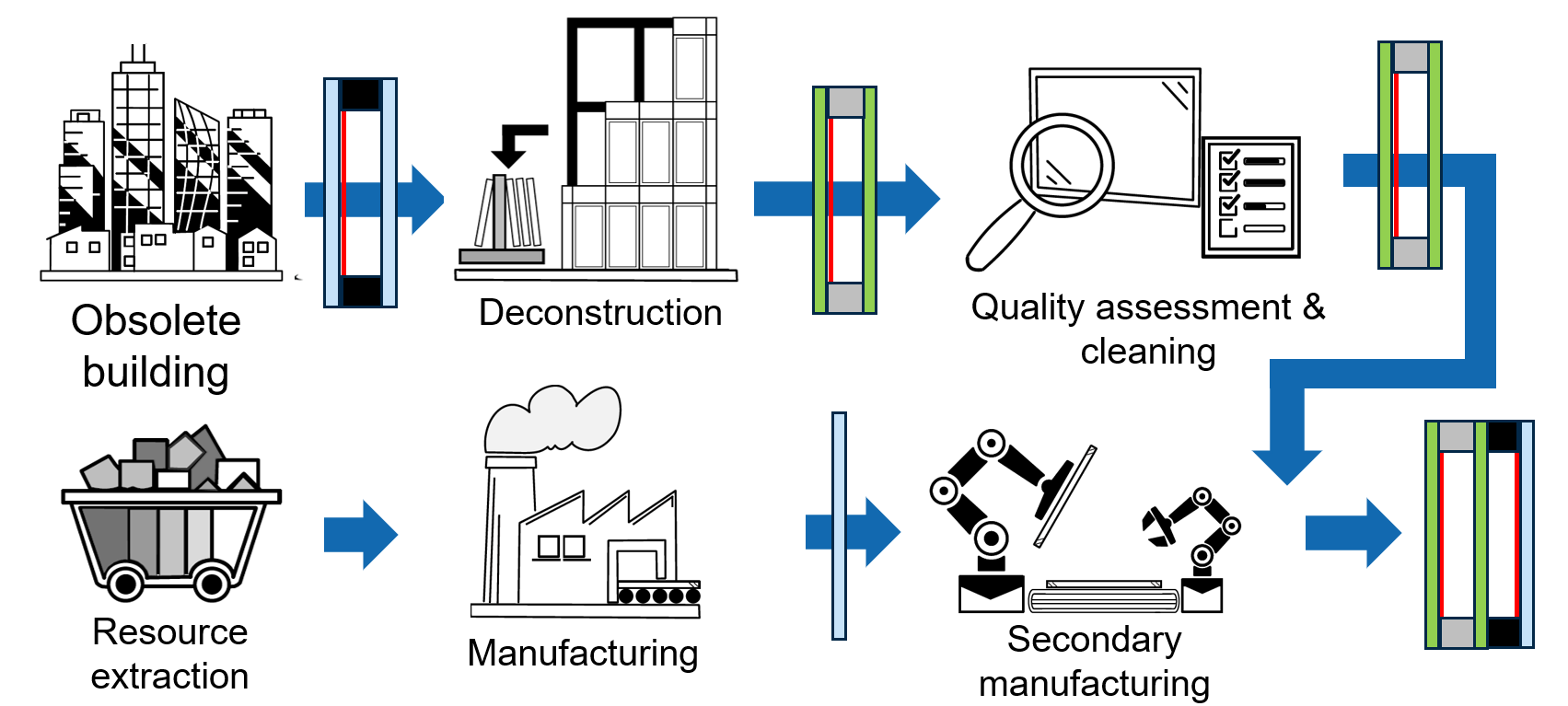
Creating closed material loops through value-retention processes is essential for circular economy (CE) strategies in construction, particularly for energy-intensive materials such as glass in insulating glass units (IGUs). In practice, IGUs are often demolished with a façade and treated as mixed construction-and-demolition waste, causing material dissipation and avoidable environmental burdens. Although circular approaches for IGUs are emerging, comparative life cycle impact assessments (LCIA) across realistic system boundaries and disassembly practices remain scarce due to construction diversity, limited data availability, and uncertainties in disassembly processes. This study addresses this gap by providing reproducible LCIAs of promising IGU end-of-life (EoL) scenarios based on ecoinvent data and literature. Prospective scenarios for treating obsolete IGUs and processing components into triple-glazed IGUs resemble a "grave-to-gate" phase beyond an IGU's first life. This phase incorporates sequences of disassembly, quality assessment, transport and secondary manufacturing to quantify Global Warming Potential in kg CO2-equivalent of scenarios per square meter functional unit. Modelling approaches include best practice assumptions and supply-based flow variations. Results show promising potential in reducing triple IGUs impact by remanufacturing. Sensitivity analysis for transports and process parameters were conducted and show that the acceptance rate during qualification is most significant for sustainable pathways. Analysis of transports imply benefits of aggregating qualification and disassembly steps to dismantling. This study's results contribute to data-driven selection of sustainable pathways and to understanding the relevance of future research topics in circularity of architectural glass.