Flexural Testing of Glass Beams Containing Artificial Inclusions
DOI:
https://doi.org/10.47982/cgc.10.729Published
Issue
Section
License
Copyright (c) 2026 Wilfried Damen, Telesilla Bristogianni, Mauro Overend, Faidra Oikonomopoulou

This work is licensed under a Creative Commons Attribution 4.0 International License.
Abstract
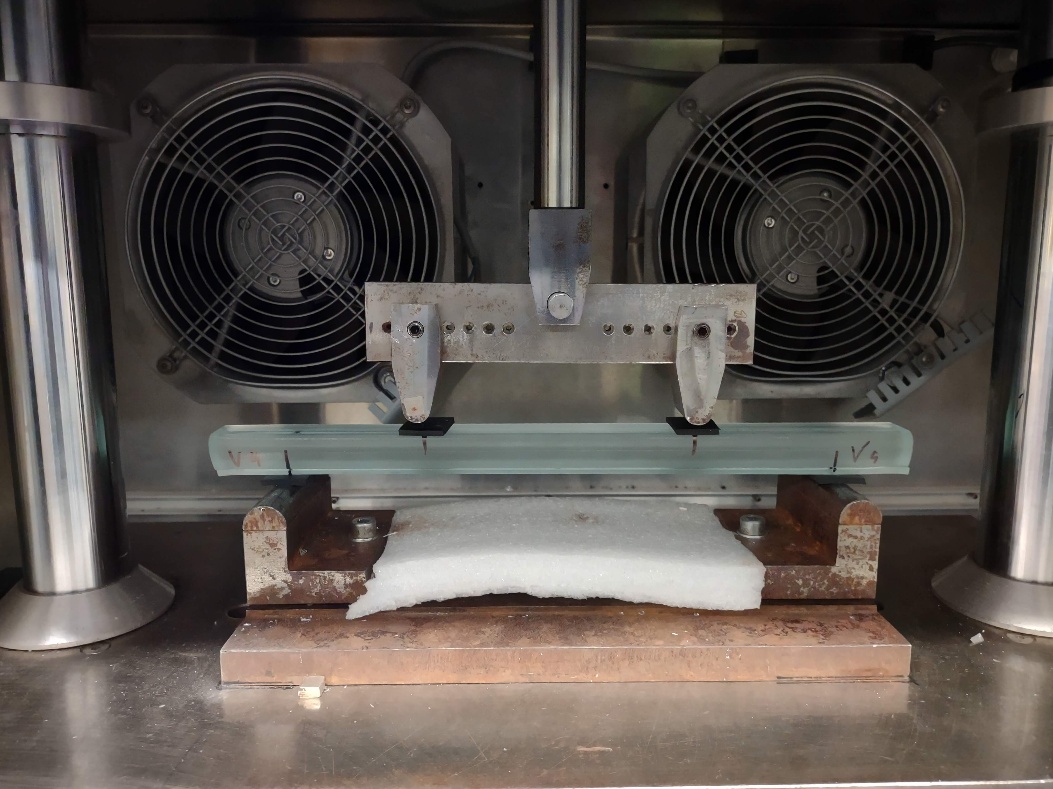
Despite having a high recycling potential, most waste glass streams are currently downcycled or landfilled. Often, recycling is considered technically and economically unfeasible due to the presence of contamination. Recent research has proved the potential of recycling contaminated waste glass through casting, without removing all types of contamination. However, this approach can result in a wide variety of inclusions within the material bulk, which can negatively impact the structural performance of the material. The precise relation between bulk inclusions and glass strength is, however, not fully understood. This research aims to assess how bulk inclusions of different material compositions affect the tensile strength of glass elements. This is studied through four-point bending experiments of beams with introduced artificial inclusions of controlled composition, size, location and orientation. From literature, six categories of inclusions are identified that represent different failure mechanisms, based on the thermal expansion coefficient, toughness and bulk modulus of their material. Accordingly, different materials are selected to recreate these categories. These are embedded in the glass in the form of 2 mm diameter spheres, placed between layers of soda-lime float glass which are then fused together at 750oC. The inclusions are placed near the surface of the beams so that they are subjected to tension in the subsequent four-point bending tests. After failure, the obtained fracture strength and fractograpic observations are evaluated using fracture mechanics theory to establish how the different material properties of the various inclusions affect the tensile strength of glass. The results help predict which types of inclusions can be accommodated within the bulk of recycled cast glass, and which negatively affect the flexural strength and should be avoided in waste glass manufacturing.