Downloads
DOI:
https://doi.org/10.47982/cgc.10.727Published
Issue
Section
License
Copyright (c) 2026 Jackson Jewett, Faidra Oikonomopoulou, Telesilla Bristogianni, Josephine Carstensen

This work is licensed under a Creative Commons Attribution 4.0 International License.
Abstract
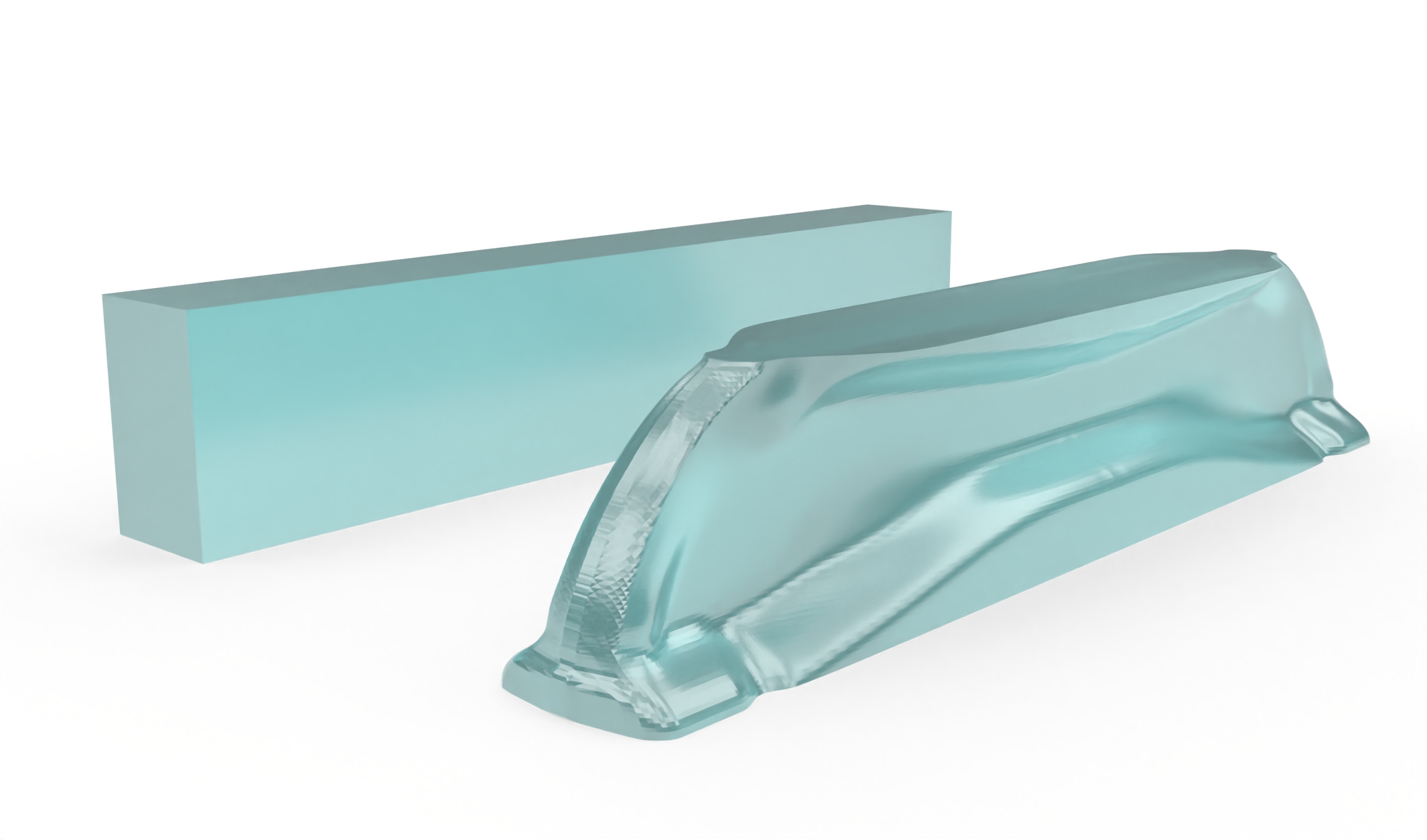
Cast glass offers vast forming potential, enabling the creation of expressive three-dimensional structural components that can effectively exploit the material’s high compressive strength. Yet, despite these advantages, massive cast glass elements remain largely unexplored in architecture. The primary obstacle lies in the exceptionally long annealing times required, which increase exponentially with the thickness and mass of the components, rendering them in turn economically unfeasible for architectural use. Topology optimization has been suggested as a computational design method to minimize mass in cast glass structures, reducing annealing time and allowing for larger cast glass elements. Topology optimization algorithms must be modified to account for the unique behaviour of glass, particularly its low tensile capacity compared to its high compressive strength. This research analyses beams designed with a novel topology optimization framework for cast glass structures that is focused on reducing tension stresses. Maximum and minimum length scales are also controlled using a 2.5D design framework to ensure manufacturability. It is found that the glass-specific optimization has minimal impact on the tensile stresses within the beams. However, the optimized beams show material savings of over 31%-38% compared to conventional prismatic designs with the same maximum tension stresses. This work establishes the expected material savings using topology optimization, and acts as a useful benchmark for future physical experimentation.