Entanglement-Hydrogen Bond Dynamics in Pristine and Humidity/UV-Aged Materials
Downloads
DOI:
https://doi.org/10.47982/cgc.10.710Published
Issue
Section
License
Copyright (c) 2026 Yujia Lu, Suwen Chen

This work is licensed under a Creative Commons Attribution 4.0 International License.
Abstract
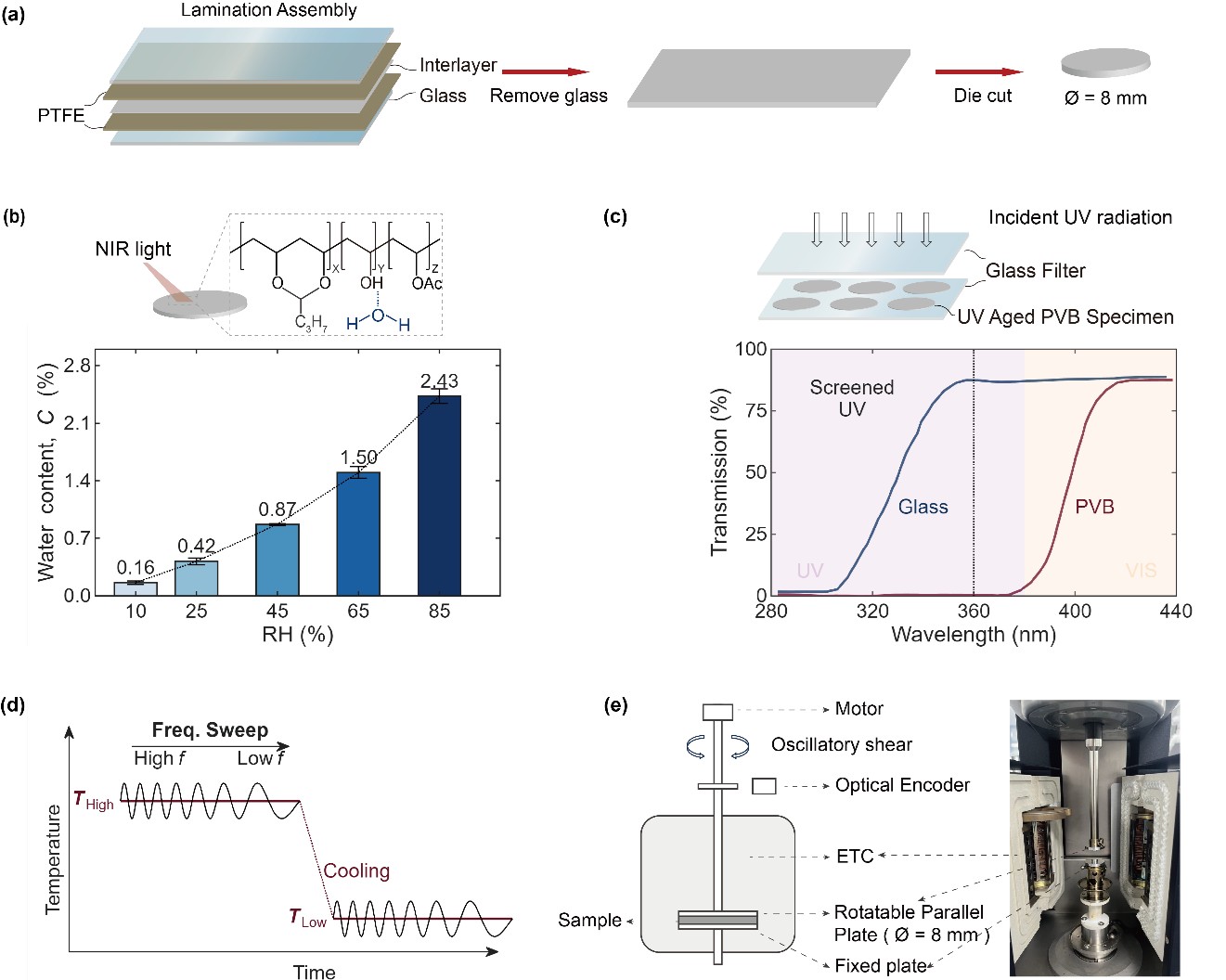
The shear response of Polyvinyl butyral (PVB) interlayers governs laminated glass structural performance, yet a unified physics-based model predicting shear modulus under environmental aging remains absent. This paper integrates shear-mode dynamic mechanical thermal analysis, solid-state nuclear magnetic resonance, and Fourier transform infrared spectroscopy to elucidate molecular mechanisms under humidity and UV exposure. Testing validates time-temperature superposition for pristine and aged states, revealing a dual-network system driven by entanglements and reversible hydrogen bonding. A time-partitioned shear modulus model, dividing relaxation into four zones with distinct molecular mechanisms, achieves high accuracy using ten interpretable parameters, surpassing traditional Prony series in efficiency and clarity. Humidity accelerates relaxation without altering modulus, whereas UV induces non-monotonic evolution. These effects are captured in the proposed model, advancing predictive modeling of environmentally responsive viscoelasticity in interlayer.