Downloads
DOI:
https://doi.org/10.47982/cgc.10.708Published
Issue
Section
License
Copyright (c) 2026 Elena Fleckenstein, Michael Engelmann

This work is licensed under a Creative Commons Attribution 4.0 International License.
Abstract
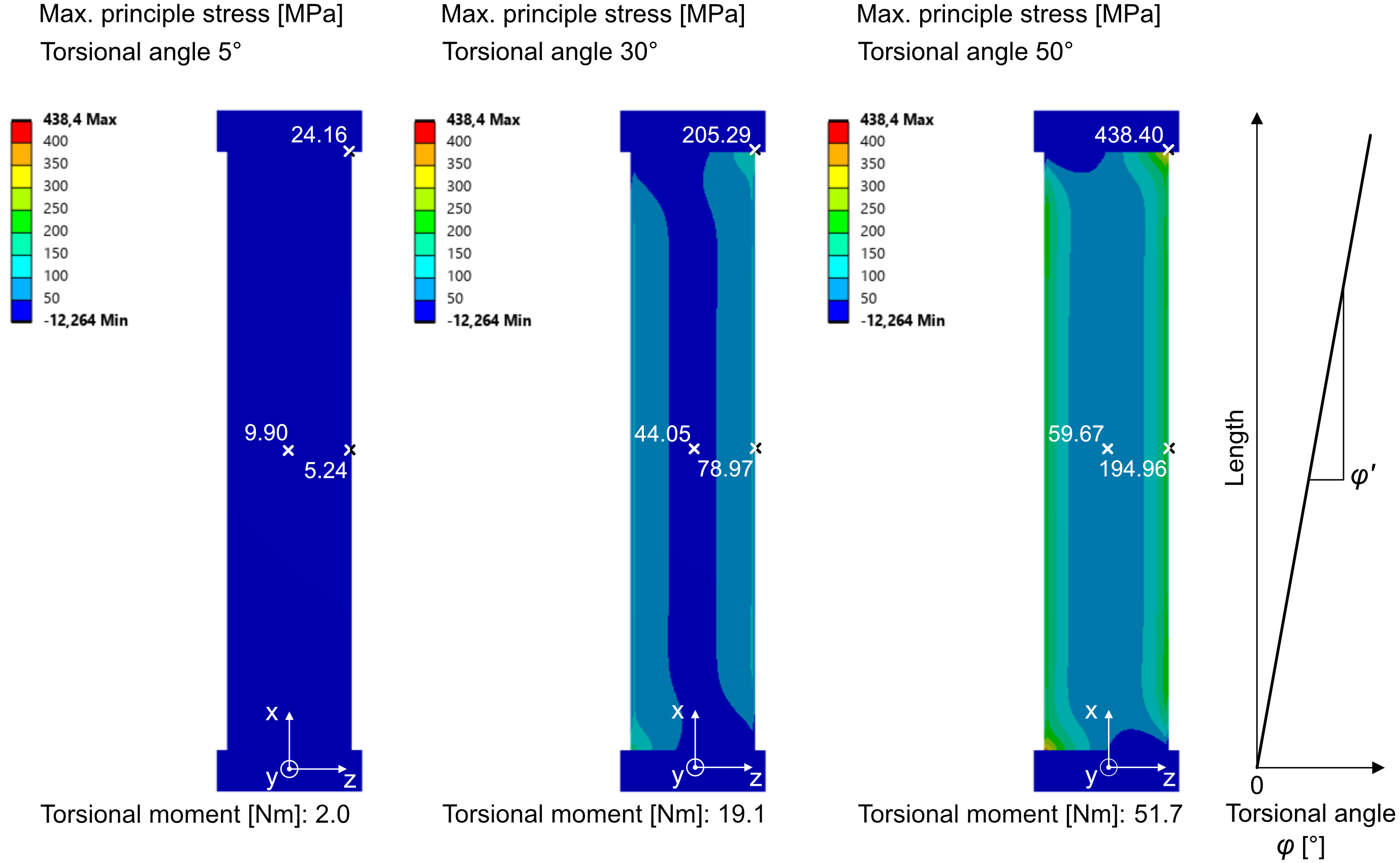
Thin glass below 2 mm in thickness is becoming increasingly interesting in façades with the growing importance of lightweight construction. Chemically strengthened thin glass offers high strength and flexibility; as a result, its large deflection capacities can be exploited by active cold bending, leading to new applications such as adaptive façades. To meet safety requirements, thin glass should be laminated. However, compared to conventional laminated safety glass, laminated thin glass (LTG) exhibits a much lower glass-to-interlayer ratio. In this study, the behaviour of LTG under torsional deformation was investigated through a long-term experiment. A test rig was developed to evaluate the long-term behaviour experimentally. Specimens composed of two 0.7 mm chemically strengthened thin glass panes with ethylene vinyl acetate (EVA) and multilayer interlayer with EVA and modified polyester (MPE) were subjected to a fixed torsional angle of 30° for 3,100 h (approx. 130 days). The torsional moment was continuously monitored to determine the time-dependent shear stiffness. Afterwards, the fixation was removed to observe the extent of shape recovery. The results showed that even after a recovery time of 800 h (> 30 days), the LTG showed permanent deformation. This highlights the necessity of accounting for the mechanical properties of the interlayer in structural design. This is particularly important for applications involving repeated deformation, such as adaptive façades.