Downloads
DOI:
https://doi.org/10.47982/cgc.10.703Published
Issue
Section
License
Copyright (c) 2026 Cas Maertens, Bert Van Lancker, Jérôme Van Alboom, Roman Wan-Wendner, Jan Belis

This work is licensed under a Creative Commons Attribution 4.0 International License.
Abstract
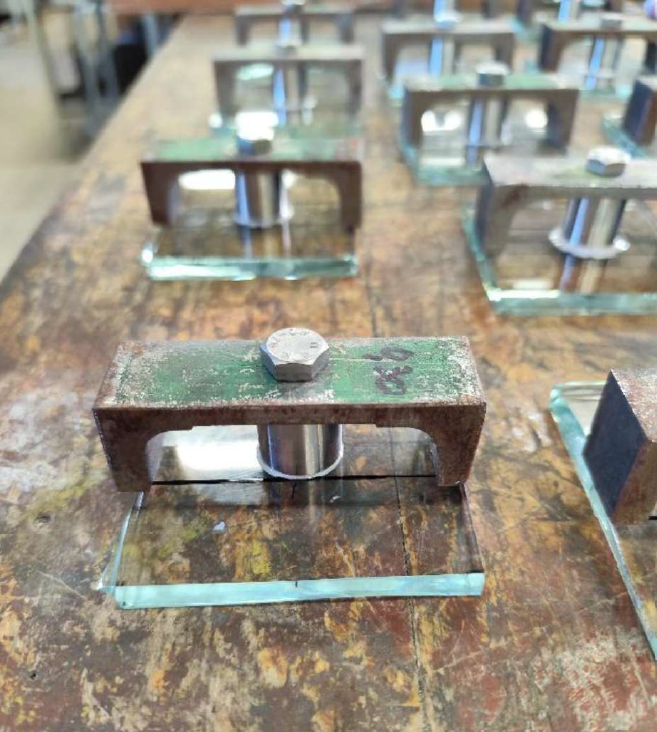
The durability of glass-steel adhesive joints is a key consideration in hybrid structural applications, where environmental exposure can alter the mechanical response of epoxy adhesives. This study examines two bonded glass-steel configurations with an unfilled (UF) and a particle filled (F) epoxy. Specimens were conditioned for 24 hours and seven days at 95 °C, -10 °C, 95% relative humidity and full water immersion, followed by pull off testing. Force and crosshead displacement were used to derive global apparent response measures, including ultimate tensile stress, apparent strain, apparent stiffness and apparent strain energy density, each evaluated relative to a 23 °C reference state. The unfilled epoxy showed the most stable behaviour, whereas the filled epoxy, despite higher strength and deformability at 23 °C, was markedly more sensitive to high humidity and low temperature. Elevated temperature conditioning produced adhesive specific and time dependent effects: short exposure increased stiffness and strength in the unfilled system, while the filled system weakened initially and recovered only partially after seven days. Moisture exposure primarily reduced stiffness, while strength and energy absorption remained relatively stable in the unfilled epoxy but decreased substantially in the filled epoxy. Failure remained predominantly cohesive within the adhesive layer, indicating that environmental influences mainly altered the bulk polymer response. The results provide an experimental basis for assessing environmental sensitivity in bonded glass-steel assemblies and support more robust adhesive selection for architectural applications.