Downloads
DOI:
https://doi.org/10.47982/cgc.10.701Published
Issue
Section
License
Copyright (c) 2026 Bert Van Lancker, Kenny Martens

This work is licensed under a Creative Commons Attribution 4.0 International License.
Abstract
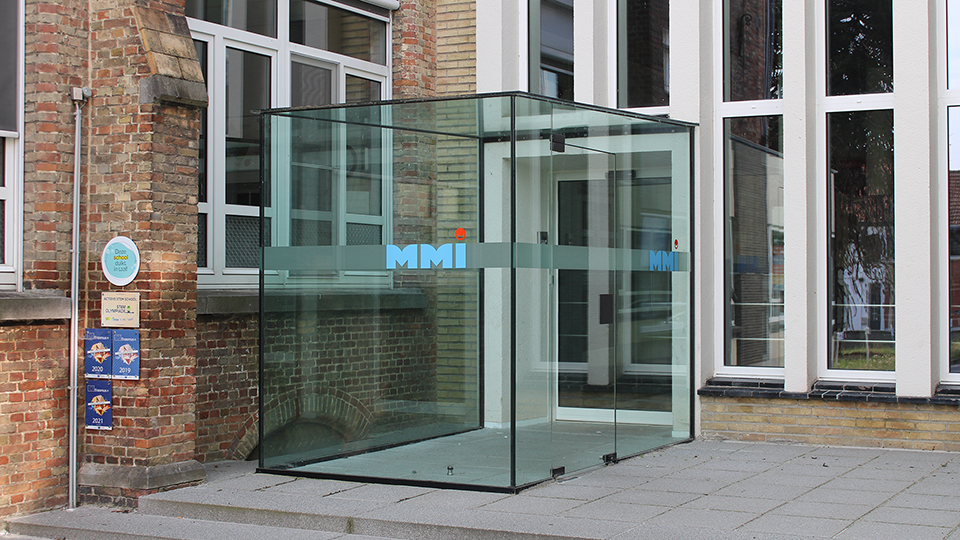
Vitroplena designed and installed an all glass pavilion serving as the entrance to a public school. The structure consists of a 3 m by 1.8 m glass box with a height of 2.5 m, constructed from 1010.2 (TTG,sPVB) laminated glass panels—combining thermally toughened glass (TTG) with structural PVB interlayers (sPVB)—that were adhesively bonded on site using a black structural silicone. One side of the pavilion is connected to the existing school façade, while the opposite side remains free standing, and a door is integrated into one of the side panels. The roof panel is slightly inclined to facilitate rainwater drainage. The pavilion is entirely self supporting: all acting loads are transferred through the glass walls and roof via the structural adhesive joints, allowing the box to behave as a single stable entity. Transparency is maximised by eliminating steel connectors and relying solely on glass and adhesive bonds. The design of the glazing and joints was carried out using finite element analyses that accounted for the viscoelastic behaviour of both the interlayers and the structural silicone. This paper presents the design process, structural calculations, and on site installation, and discusses the key challenges encountered. The resulting all glass pavilion establishes a new benchmark in advanced structural glass engineering.