Downloads
DOI:
https://doi.org/10.47982/cgc.10.700Published
Issue
Section
License
Copyright (c) 2026 Bert Van Lancker, Cas Maertens, Jérôme Van Alboom, Roman Wan-Wendner, Jan Belis

This work is licensed under a Creative Commons Attribution 4.0 International License.
Abstract
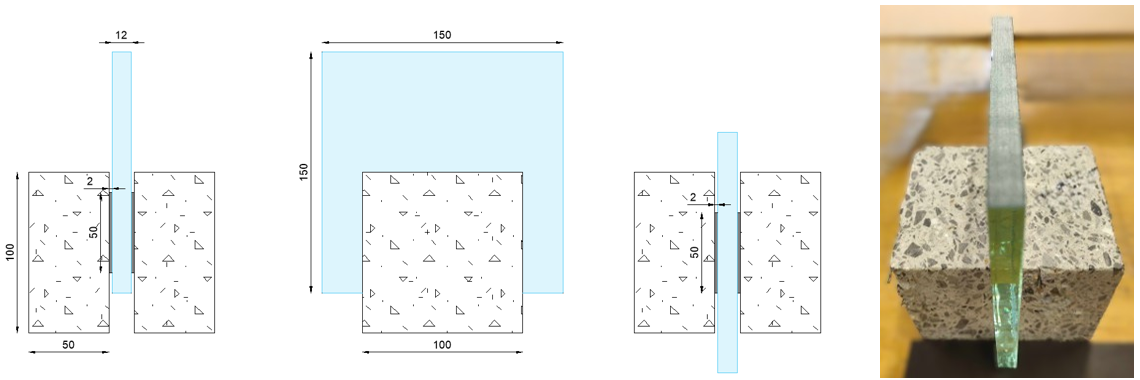
The use of adhesives in architectural glass applications is steadily increasing. To date, these applications have primarily focused on structural glass-to-metal or glass-to-glass connections in façades, typically employing flexible adhesives such as silicones and polyurethanes. Recently, however, there has been a growing interest in stronger adhesives, such as acrylates and epoxies, for all glass assemblies and for hybrid structures combining glass with materials including timber, plastics, and concrete. This emerging trend forms the basis of the present research in which glass is combined with concrete. To develop and optimise such hybrid components, finite element simulations can be employed, provided that the adhesive behaviour is accurately represented. For this purpose, experimental testing of both bulk adhesive material and bonded glass–concrete interfaces is required to establish the relevant stress–strain relationships. In this study, the mechanical properties of an epoxy adhesive selected for glass–concrete bonding are characterised through tensile and shear testing. Tensile tests are performed on dumbbell specimens, while compressive double-lap shear tests are carried out on bonded glass–concrete specimens. This paper presents the adopted test procedures based on relevant standards, the fabrication of the specimens, the resulting experimental data, a simplified material model, and the implementation in finite element software for comparison purposes.