Transfoaming Glass Waste into Acoustic Panels
DOI:
https://doi.org/10.47982/cgc.10.694Published
Issue
Section
License
Copyright (c) 2026 Ludwika Buczynska, Gabriele Mirra, Martin Tenpierik, Faidra Oikonomopoulou

This work is licensed under a Creative Commons Attribution 4.0 International License.
Abstract
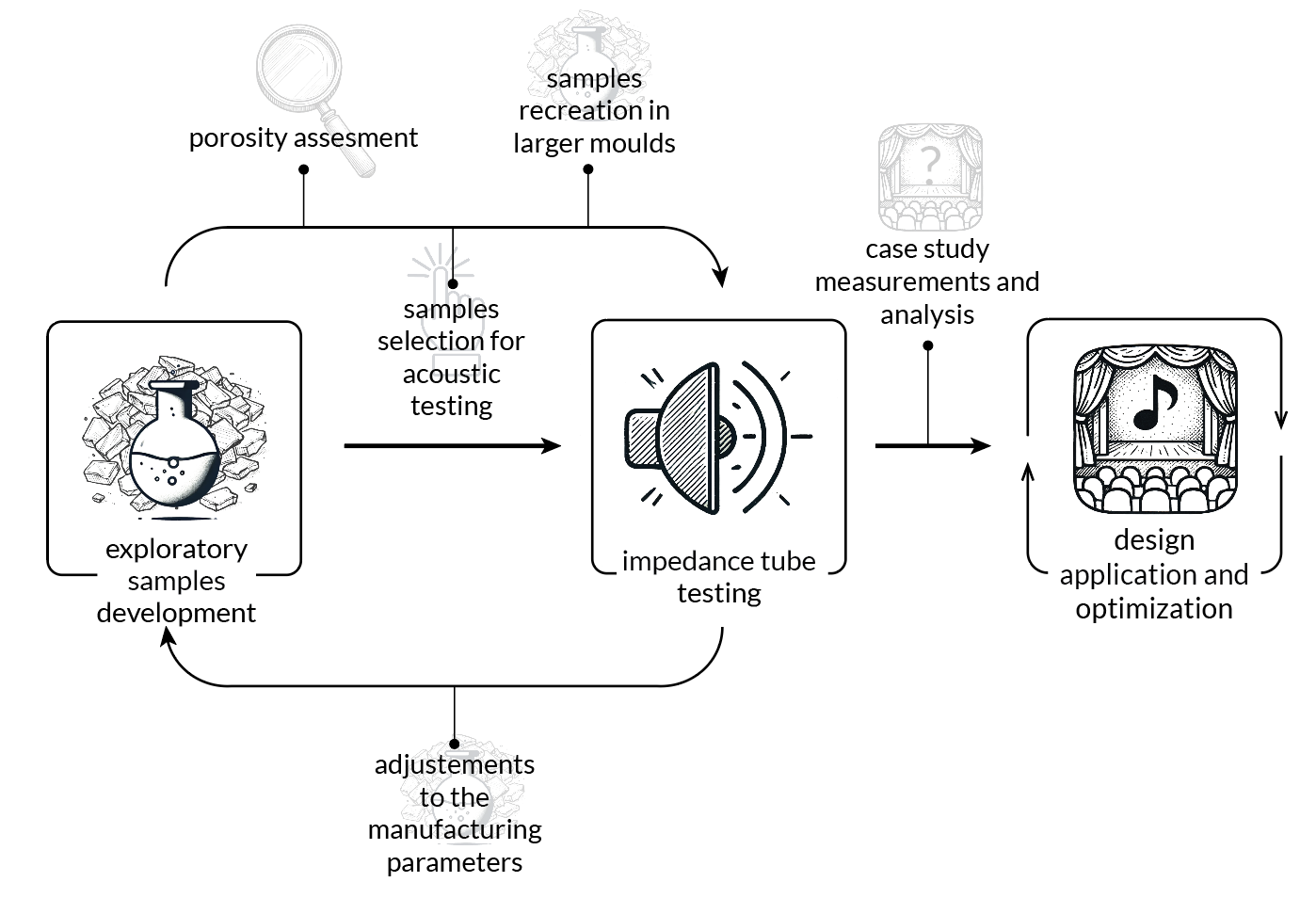
The construction sector faces increasing pressure to reduce material waste while meeting rising performance demands, including acoustic comfort in buildings. This study investigates the upcycling of several post-consumer glass waste - float-glass, light bulb glass, and contaminated mixed soda-lime cullet - into porous, sound-absorbing panels for architectural applications, targeting both circular material use and sound absorption performance. A series of foaming experiments are conducted to evaluate the influence of glass composition, foaming agents (calcium carbonate, eggshells, manganese dioxide), cullet size and arrangement, and firing schedule on pore formation and structural integrity. To assess applicability as a safe and redundant building component, the feasibility of fusing foamed glass to a float glass pane is also tested. The most promising material variants are then characterized in terms of acoustic performance via impedance tube measurements on Ø100 mm and Ø29 mm specimens to assess how the material’s porosity affects its sound absorption properties. Results show that stable, open porous structures can be achieved at a max. temperature of 790-860°C, with eggshells showing strong compatibility as a foaming agent across all tested glass waste types. Acoustic measurements revealed high sound absorption coefficients (up to 1.0) in the mid-to-high frequency range (≃ 1000 Hz), even for specimens made of contaminated mixed glass cullet. To support architectural integration, a computational design workflow that automatically generates and analyses different spatial arrangements of the foamed glass panels was developed to optimize the acoustic response of an architectural volume. The 2200m³ performance hall of the Theatre Hall at TU Delft X served as a case study. The workflow produced panel arrangements that enhance sound clarity while maintaining a desirable reverberation time in the hall. The findings demonstrate that foamed glass derived from diverse waste streams can be effectively reintroduced into the construction chain as a high-performance acoustic component for architectural applications. The presented workflow can be repurposed for other applications involving different venues and acoustic targets.