Downloads
DOI:
https://doi.org/10.47982/cgc.10.693Published
Issue
Section
License
Copyright (c) 2026 Max Stoppel, Pietro Di Biase

This work is licensed under a Creative Commons Attribution 4.0 International License.
Abstract
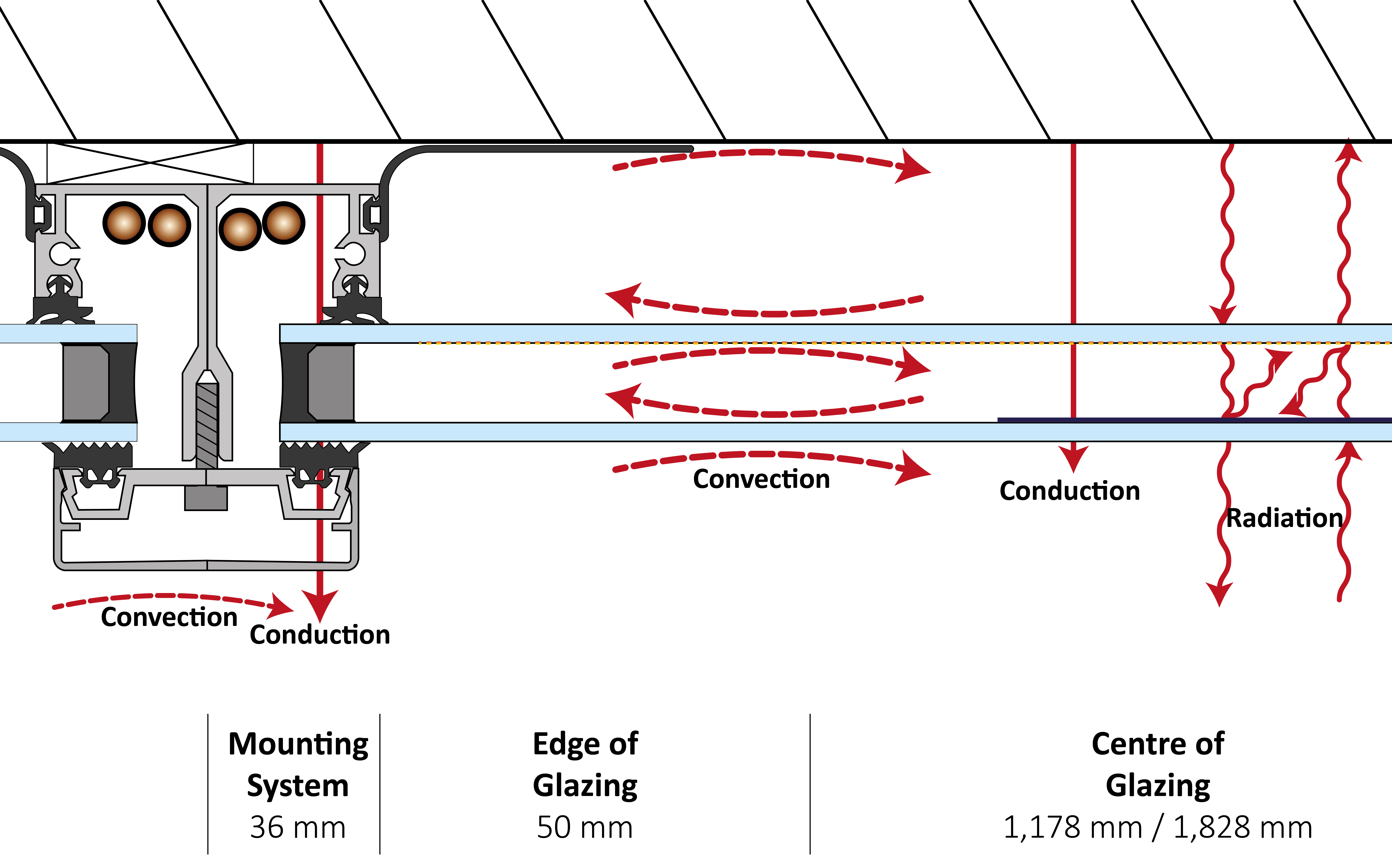
As a boundary between interior and exterior, the building envelope and its thermal properties are crucial for heat lost and indoor comfort. Dynamic building envelopes offer the potential to optimize buildings in terms of energy efficiency, save resources, and adapt to the needs of users. EnergySkin is a designed dynamic building envelope, that actively controls heat flow through existing façades by regulating the external wall temperature. Developed as a serial solution, it comprises a mounting system and façade modules. The basic element of the façade modules is an insulated glass unit (IGU). A contacted low-emissivity glass coating functions as an electrical heater. The necessary energy is obtained from photovoltaics integrated into the IGU and from supporting battery storage units included in the mounting system. This paper presents the analysis of internal heat flows, temperatures profiles and fluid flows using numerical methods and computational fluid dynamics. Partial investigations focus on the subsystems of the glazing centre and edge as well as the mounting system. The overall system is examined analysed as a conjugate heat transfer between EnergySkin, the existing structure and an airgap required to compensate for unevenness in the façade. The total results are discussed in regards to its thermal behaviour in the context of heat loss and output demand. Finally, directions for future development of Energy Skin are outlined.