A Case Study in The Netherlands
DOI:
https://doi.org/10.47982/cgc.10.688Published
Issue
Section
License
Copyright (c) 2026 Esther Geboes, Ed Melet, Pieter Bons, Waldo Galle, Niels De Temmerman, Elke van Nieuwenhuijzen

This work is licensed under a Creative Commons Attribution 4.0 International License.
Abstract
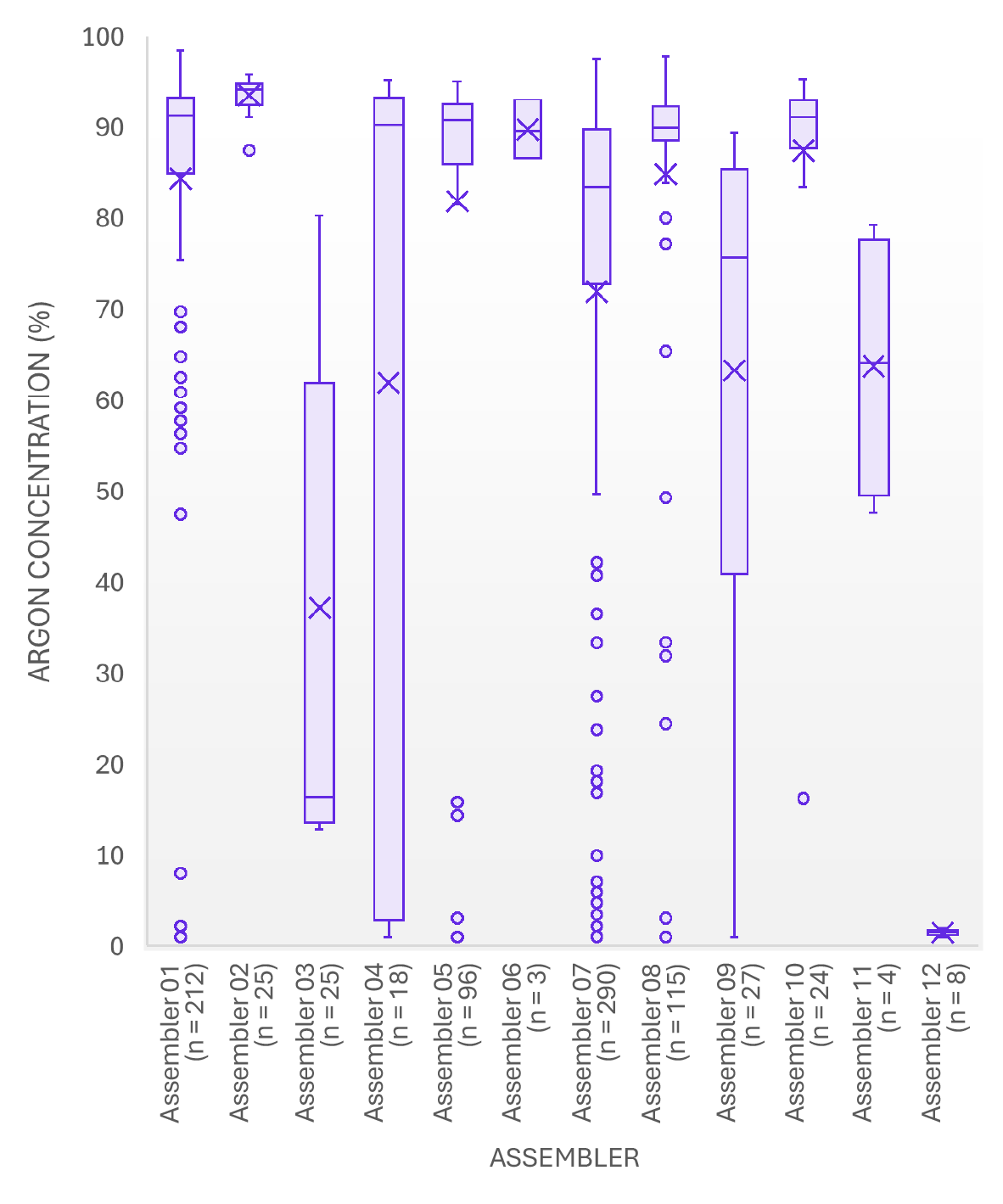
Reuse of entire insulating glass units (IGUs) is a high-level circular strategy to reduce material use, energy demand, and CO2 emissions from manufacturing, but remains little studied. This study explores the technical reuse potential of 930 argon-filled double glazed IGUs in 43 Dutch buildings, using residual argon gas concentration as screening criteria for reuse. It assesses associations with IGU age, orientation, building, and assembler, and reviews the scalability and practicality of the proposed screening method. The reuse potential is explored through three perspectives: an availability-driven approach, a performance-driven threshold (T85) of ≥85% argon based on gas-fill requirements in EN1279, and a condition-driven threshold (T80) of >80% reflecting allowable argon diffusion over a 25-year service life as assumed by EN1279. Data was collected using spacer codes and the Sparklike Laser Portable. Results show that 54% of tested IGUs meet T85 and 75% meet T80. Although trends were observed for age, orientation, building, and assembler, none proved reliable as complementary pre-screening criteria for reuse. The proposed in-situ screening method is time-consuming; simplifying the protocol, integrating emissivity measurements, U-value calculation, and standardizing spacer codes can improve efficiency and reuse decision-making. When applying T80 for reuse, monitoring edge seal performance over time is advised. Further research should balance economic and environmental considerations (e.g. operational energy loss) for both product-level requirements and building-level reuse requirements.