Downloads
DOI:
https://doi.org/10.47982/cgc.10.687Published
Issue
Section
License
Copyright (c) 2026 Guillermo Casas, Adrián Betanzos, Louis Moreau

This work is licensed under a Creative Commons Attribution 4.0 International License.
Abstract
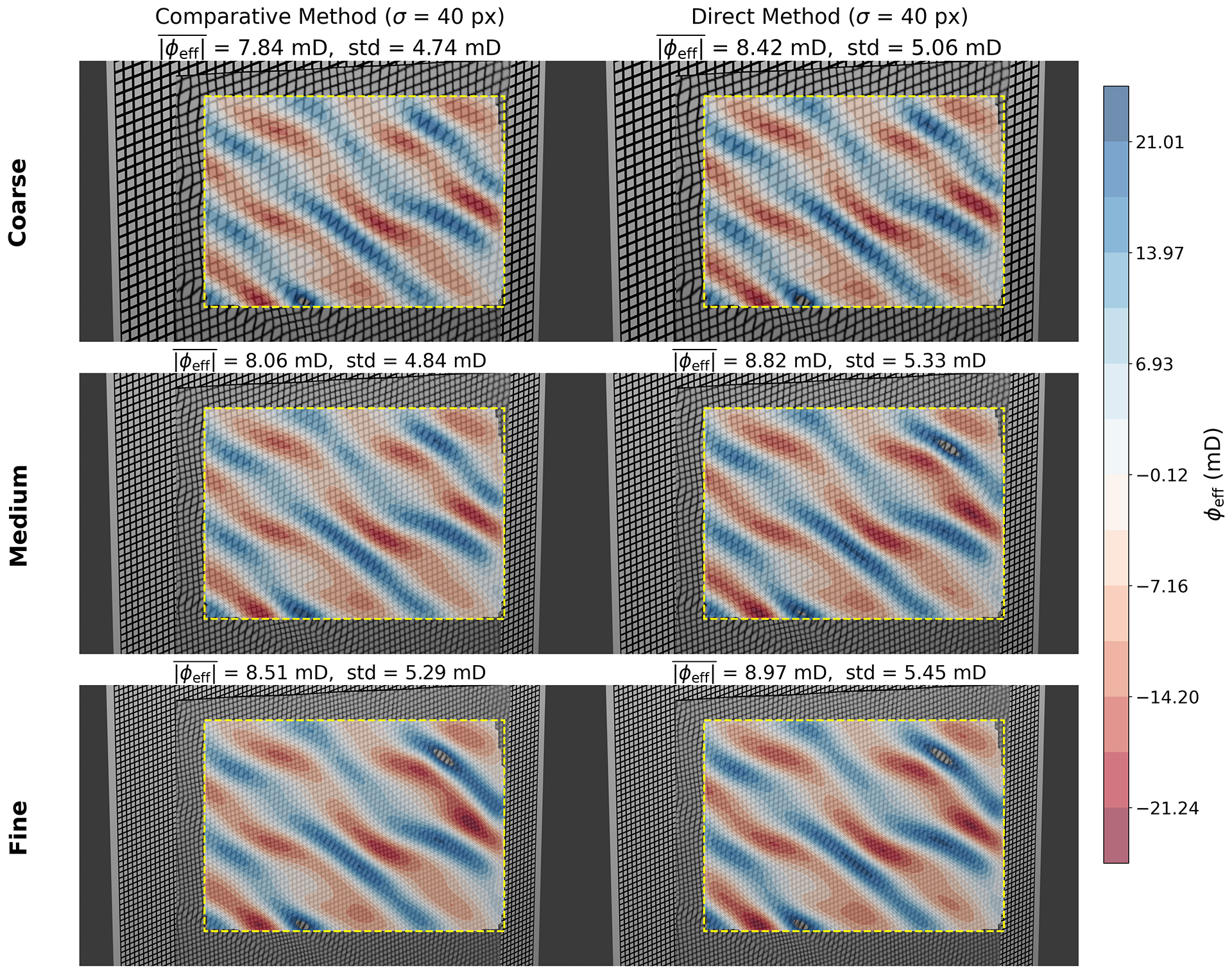
Architectural panelled glass lacks an objective method for assessing optical distortion: surface topography captures only reflected flatness (weakly correlated with the through-glass distortion observers report) and visual inspection is neither reproducible nor deployable on installed panels. We address this gap with an image-based methodology that measures distortion as observers perceive it: the apparent displacement of a background pattern seen through the glass, reported as a two-channel field of sphere-equivalent optical power and cylinder-equivalent astigmatism. The methodology adapts Fourier Transform Profilometry and phase-measuring deflectometry to architectural glass, and introduces a reference-free Direct Method that recovers the undistorted grid via a RANSAC homography fit, removing the need for a glass-less calibration and enabling deployment both in-factory and in-situ. We design and validate the Distortion Analyzer within a virtual pipeline of ray-traced simulations with known ground truth. Validation against the Pipeline's independent analytical forward model confirms spatial agreement, convergence under grid refinement, and rotational stability. Physical validation and perceptual calibration remain as next steps.