Experimental Comparison of Four European Case Studies (2012–2026)
DOI:
https://doi.org/10.47982/cgc.10.682Published
Issue
Section
License
Copyright (c) 2026 Jorge Hidalgo

This work is licensed under a Creative Commons Attribution 4.0 International License.
Abstract
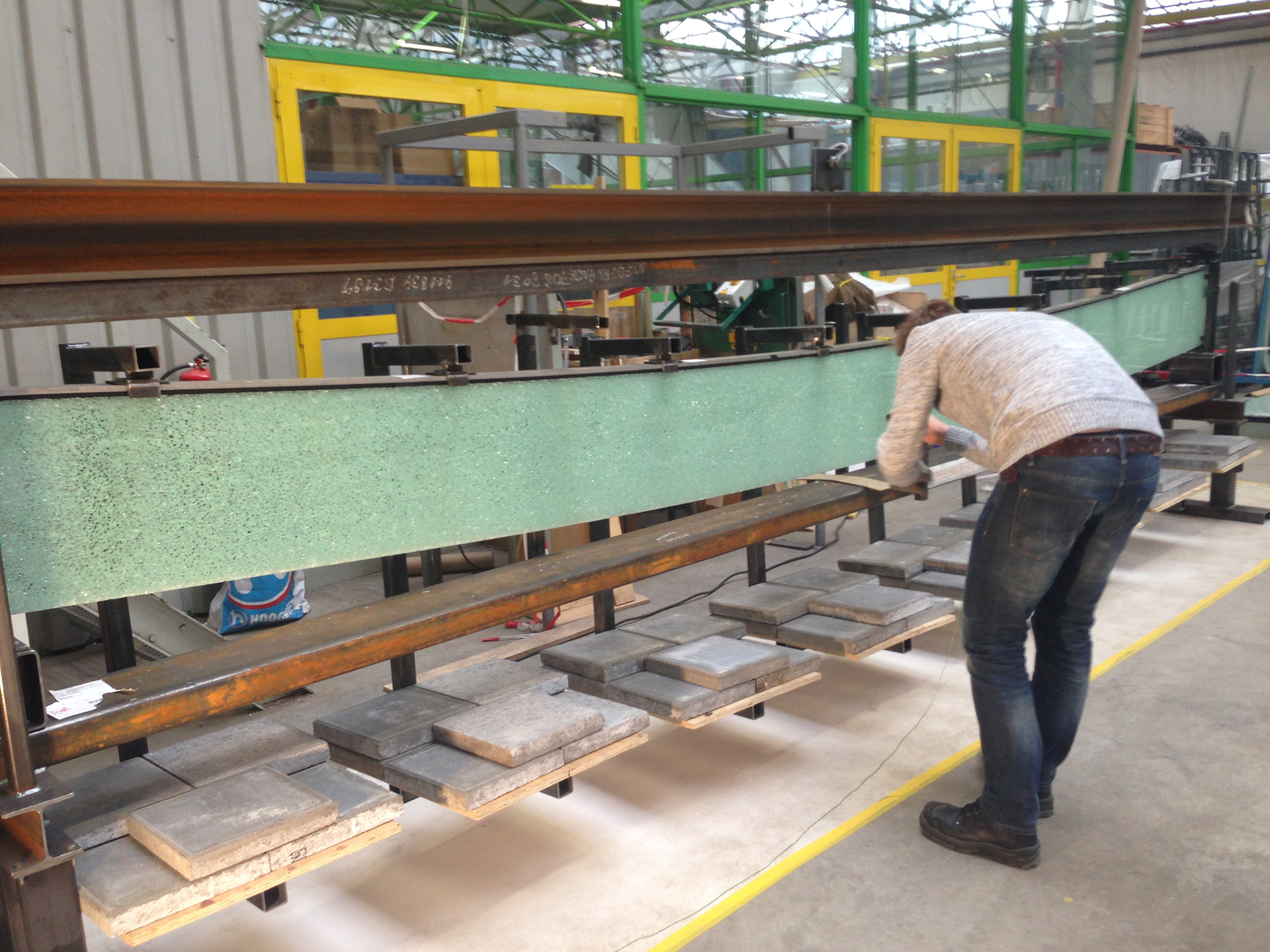
The increasing use of all-glass structures has been enabled by advances in glass manufacturing, allowing glass beams to be employed as primary load-bearing elements. Owing to the intrinsic brittleness of glass and the absence of visible pre-failure indicators, ensuring adequate post-fracture behaviour is essential to maintain structural integrity and prevent progressive collapse. This paper presents an experimental investigation into the post-fracture behaviour of four full-scale glass beams from realised projects constructed between 2012 and 2026 in Ireland, France and Italy. The study evaluates the residual load-bearing capacity of different laminated glass configurations, focusing on the influence of laminate typology, assembly techniques and redundancy systems. Particular attention is paid to the role of alternative load paths in preserving structural stability after localised failure. The results reveal substantial differences in post-fracture performance between the tested configurations, highlighting the critical importance of material selection and structural detailing. The findings contribute to the definition of robustness and damage-tolerance criteria for load-bearing glass elements and support the experimental validation of numerical design approaches.