Downloads
DOI:
https://doi.org/10.47982/cgc.10.678Published
Issue
Section
License
Copyright (c) 2026 Gergana Rusenova, Julian Länge, Thiemo Fildhuth , Anna Buksak, Timon Peters, Isabell Ayvaz, Matthias Haller, Roman Schieber, Ulrich Knaack

This work is licensed under a Creative Commons Attribution 4.0 International License.
Abstract
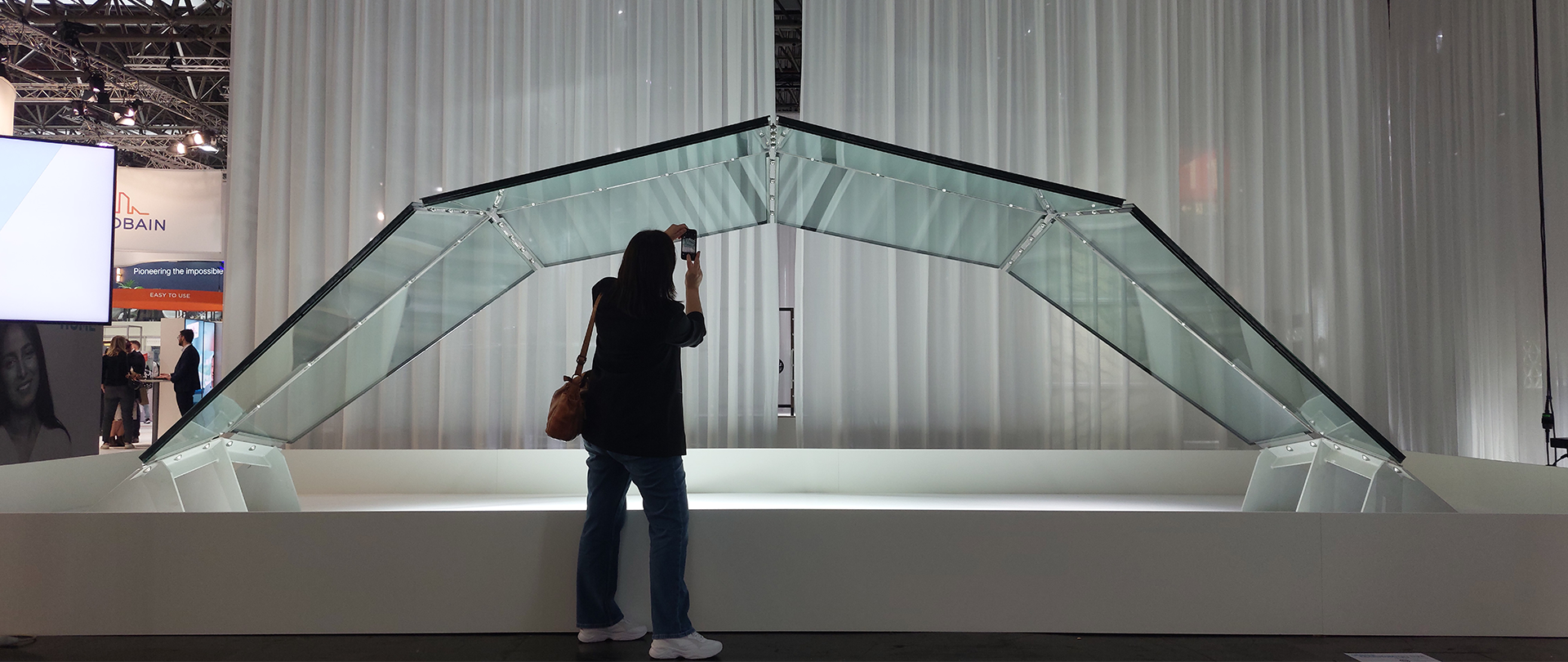
For more than two decades, glass shell structures have shaped architecture for their transparency and strength, traditionally using steel lattices with non-load-bearing glass. This project explores fully glass-based envelopes without conventional profiles, pushing the limits of transparent structural design while targeting material efficiency and CO₂ reduction. It investigates frameless constructions with laminated steel fittings between panes, enabling glass as a load-bearing, thermally effective envelope. Methods combine thermal simulations, structural detailing, and parametric automation. A novel linear fitting system for insulating glass was refined through iterative prototyping, laser welding, and tolerance strategies. Fabrication challenges—especially welding inconsistencies—underscored the need for tighter design-manufacturing coordination. Thermal simulations across five climate zones informed a custom visual programming tool for interactive temperature analysis and design guidance. The parametric workflow automates geometry, fabrication data, and assembly logic for applications from façades to yacht canopies. A full-scale Glasstec 2024 mock-up demonstrated both potential and fabrication sensitivity, highlighting the importance of iterative, feedback-driven development in frameless glass architecture.