Downloads
DOI:
https://doi.org/10.47982/cgc.10.674Published
Issue
Section
License
Copyright (c) 2026 Michelle Grüne, Jan Kückelheim, Michael Marré, Bernd Ahrens, Stefan Schweizer

This work is licensed under a Creative Commons Attribution 4.0 International License.
Abstract
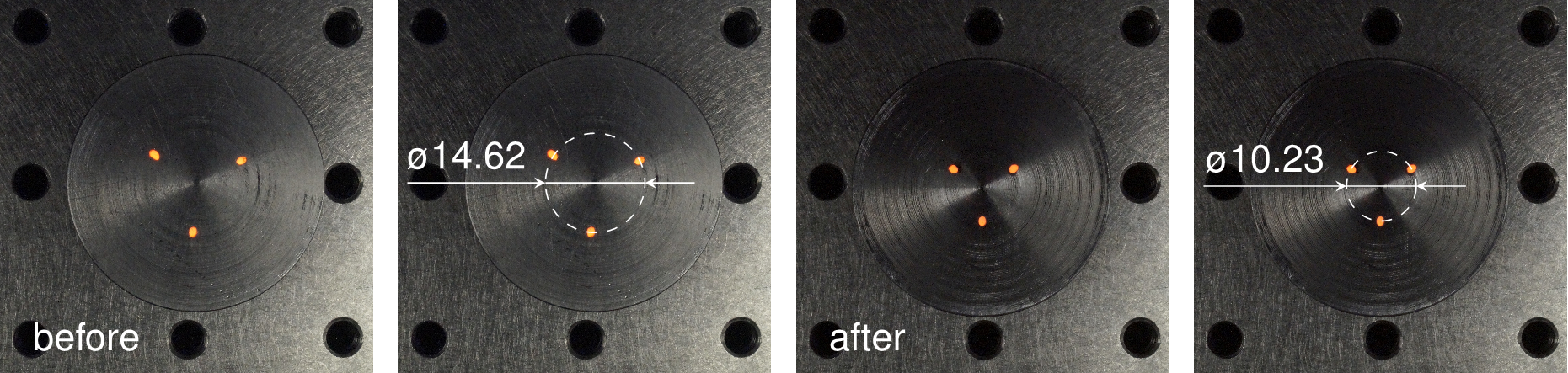
Glass, in particular borate glass, is not only a very robust and hard material, but also offers good solubility for lanthanide ions. The lanthanide ions serve as luminescence centres in the glass system and emit a characteristic luminescence when excited by light in the ultraviolet/blue spectral range. The triply ionized lanthanide europium (Eu3+) enables a very intense red luminescence that is clearly visible even under strong contaminated conditions. Such luminescent glasses can be integrated into metallic tools for non-destructive, optical wear measurements. For this, the glass is incorporated into tool areas that are subject to abrasive wear. A key challenge of this approach is to match the hardness of the glass to that of the tool steel so that both have the same wear rate. In borate glass, this can be achieved by changing the ratio of network modifier to network former. Deep, converging holes are drilled into the tool and filled with an Eu3+-activated phosphor. As abrasion increases, the distance between the holes decreases. Measuring the distance between the red luminescent holes provides information about the degree of wear. The approach enables predictive maintenance, pre-vents tool failures and reduces production downtime, thereby increasing process reliability.