Ismaili Center Houston
Downloads
DOI:
https://doi.org/10.47982/cgc.10.669Published
Issue
Section
License
Copyright (c) 2026 Tommaso Baudone, Jonas Hilcken, Felix Schmitt, Ladislaus Balint, Thomas Fritsche

This work is licensed under a Creative Commons Attribution 4.0 International License.
Abstract
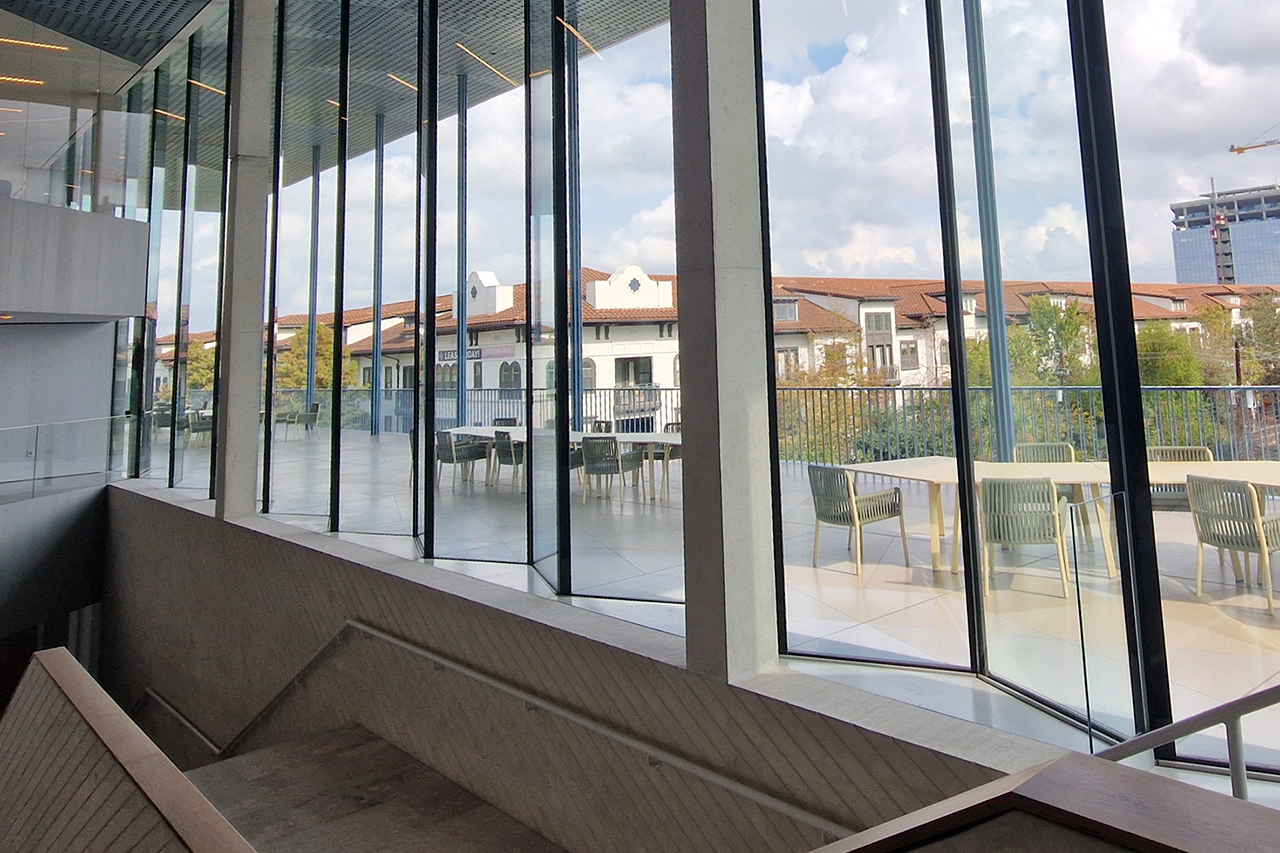
Following London (1985), Vancouver (1985), Lisbon (1998), Dubai (2008), Dushanbe (2009) and Toronto (2014), the Ismaili Center Houston was established in 2025. Commissioned by the Aga Khan, spiritual leader of the Shia Ismaili Muslims, and designed by Farshid Moussavi Architecture, the Center functions as both a place of worship and a venue for educational, cultural and social events. The architectural envelope – designed, engineered and built by Josef Gartner – stands out for its combination of traditional Persian architecture (including ceramic mosaics and stone screens) and contemporary façade technology (such as glass fins and light steel). One of the most remarkable features is the 610 m² folded plate glass façade, spanning up to 9 m on the eastern elevation and working as a folded structure. Folded structures are self-supporting, three-dimensional structures made up of flat panels that are joined together. They are highly dimensionally stable and enable slender constructions. However, challenges lie particularly in the design of the corner details and the supports. This article presents an overview of the project, including the folded plate glass façade and its details, from the initial concept to the final installation.